01 - Key AI Adoption Statistics for 2026
Last updated: 21 October 2026
Every number on this page links to the organization that collected it: government statistics agencies, research firms and the original studies. We checked each figure against its source and say what it measures. Several of the most-quoted AI statistics, including "95% of AI pilots fail" and "80% of AI projects fail", don't say what people think they say.
- 23.8% of US employer businesses used AI in the past two weeks. 27.7% expect to within six months. (U.S. Census Bureau, Oct 2026)
- About 35% of UK businesses with 10 or more employees use AI, but only 10% of those use it extensively. (ONS, Jul 2026)
- 19.95% of EU businesses with 10 or more employees used AI in 2025, and 55.03% of large ones. (Eurostat, Jun 2026)
- 42% of companies abandoned most of their AI initiatives before production, up from 17% a year earlier. (S&P Global Market Intelligence, May 2025)
- Only 25% of leaders in Deloitte's survey have moved 40% or more of their AI experiments into production. (Deloitte, Jan 2026)
- 56% of CEOs say AI has brought neither more revenue nor lower costs. Only 12% say it brought both. (PwC, Jan 2026)
- 89% of organizations report measurable value from AI, but only 12% consistently weigh that value against the cost. (KPMG, Oct 2026)
- MIT's "95%" is not a pilot failure rate. It is the share of organizations reporting zero return from generative AI, from 52 interviews and a survey of 153 leaders. (MIT NANDA, Jul 2025)
- 2% of large organizations had deployed AI agents at scale in Capgemini's 2025 survey. (Capgemini, Jul 2025)
- Customers are about three times more likely to use third-party GenAI tools than a company's own chatbot to fix a service problem. (Gartner, Jul 2026)
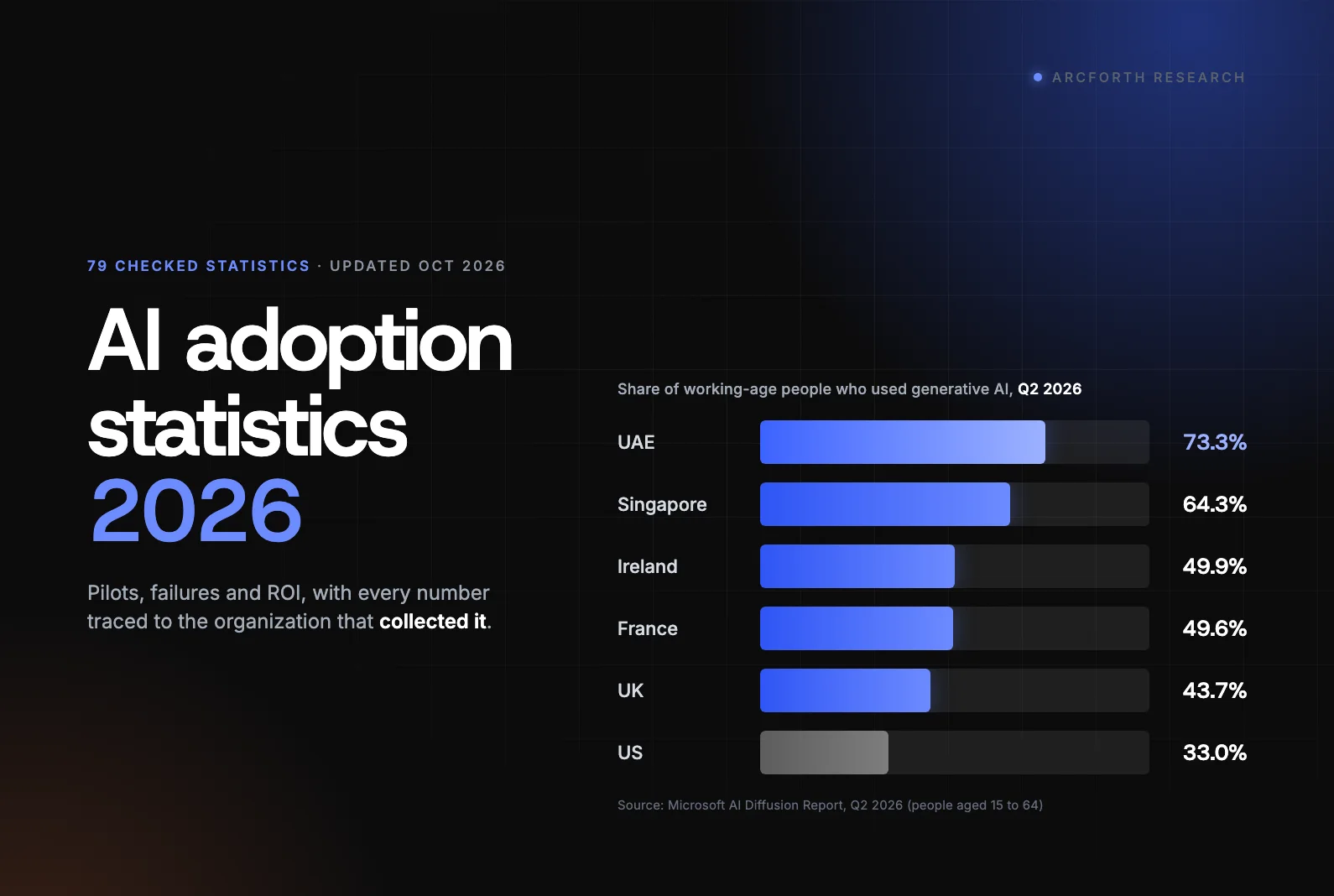
- 73.3% of the UAE's working-age population uses generative AI, the highest share in the world. The US is at 33.0%. (Microsoft, Sep 2026)
- Worldwide AI spending will reach $2.7 trillion in 2026, up 49.5%, Gartner forecasts. (Gartner, Sep 2026)
02 - What Percentage of Businesses Use AI?
Between about one in five and one in three, depending on the country and the size of the business. Surveys of executives at large companies report much higher numbers.
- 23.8% of US employer businesses used AI in at least one business function in the previous two weeks, and 27.7% expect to within six months. (U.S. Census Bureau BTOS, Oct 2026)
- 37% of US firms with 250 or more employees used AI, against less than 20% of firms with four or fewer employees. (U.S. Census Bureau, May 2026)
- About 35% of UK businesses with 10 or more employees use AI, up from about 12% in late 2023. (ONS, Jul 2026)
- Counting the smallest firms too, 28% of UK businesses with 0 to 9 employees use AI, against 49% of those with 250 or more.
- 19.95% of EU enterprises with 10 or more employees used AI in 2025, up 6.47 percentage points on 2024. (Eurostat, Jun 2026)
- In the EU, 55.03% of large enterprises used AI, against 30.36% of medium and 17% of small ones.
- 89% of respondents to McKinsey's 2026 global survey say their organization regularly uses AI in at least one business function, and 44% say AI is scaling across the company. (McKinsey, Aug 2026)
How to read these: Census, ONS and Eurostat survey representative samples of businesses. McKinsey surveys executives and managers whose companies skew large. Both are useful, but they measure different things, so don't put them side by side as if they agree or conflict.
Often misquoted: "89% of companies use AI." McKinsey's figure is the share of its survey respondents, not of all businesses.
03 - Which Industries Use AI the Most?
Information, finance and professional services lead. Construction and retail trail.
- In the US, 39.7% of businesses in the Information sector and 33.9% in Finance and Insurance used AI as of May 2026, when the national rate was 19.8%. About 14% of retailers did. (U.S. Census Bureau, May 2026)
- In the EU, 62.52% of information and communication enterprises and 40.43% of professional, scientific and technical firms used AI in 2025. Every other sector was below 25%, down to 10.79% in construction. (Eurostat, Jun 2026)
- In the UK, 58% of information and communication businesses use AI, against 13% in construction. (ONS, Jul 2026)
04 - Which Countries Use AI the Most?
The UAE and Singapore lead the world in personal use of generative AI. Denmark leads EU business adoption.
- 18.8% of the world's working-age population used generative AI in June 2026: 28.8% in the Global North and 16.2% in the Global South. (Microsoft, Sep 2026)
- The UAE (73.3%) and Singapore (64.3%) lead by a wide margin, followed by Ireland (49.9%) and France (49.6%). (Microsoft AI Diffusion Report, Sep 2026)
- The UK ranks 8th at 43.7%, and the US 21st at 33.0%.
- Among EU businesses, Denmark leads at 42.03%, followed by Finland (37.82%) and Sweden (35.04%). Romania is lowest at 5.21%. (Eurostat, Jun 2026)
How to read these: Microsoft estimates the share of people aged 15 to 64 who used a generative AI product, from its own telemetry. It says its next report will widen the measure to newer tools, which it expects to raise most countries' numbers. Eurostat counts businesses, not people.
05 - How Many People Use ChatGPT and Other AI Chatbots?
About half of American adults use AI chatbots, and 44% use ChatGPT. Worldwide, ChatGPT reached about 10% of adults by mid-2025.
- About half of US adults use AI chatbots, including roughly one in four who use them every day. (Pew Research Center, Jun 2026)
- 44% of US adults use ChatGPT, up from 34% a year earlier.
- Adults under 50 are about twice as likely as those 50 and older to use ChatGPT: 57% against 28%.
- By July 2025, ChatGPT had been adopted by around 10% of the world's adults. (NBER, Sep 2025)
- More than 70% of ChatGPT messages are not about work, up from 53%. Practical guidance, seeking information and writing make up nearly 80% of conversations.
- Among US adults who don't use chatbots, 60% say lack of interest is a major reason, 54% worry about how their personal information will be used and 45% don't trust the answers to be accurate. (Pew Research Center, Jun 2026)
How to read these: the NBER study covers consumer ChatGPT plans only, and most of its authors work at OpenAI.
06 - How Is AI Used in the Workplace?
Many workers use AI, but few companies use it deeply.
- 38% of employed US adults use AI chatbots for tasks at work. (Pew Research Center, Jun 2026)
- Among UK businesses that use AI, only 10% use it extensively, and 15% say more than half of their employees use it in their daily work. (ONS, Jul 2026)
- UK adopters use about 1.6 AI technologies on average, up only slightly from 1.4 in late 2023.
- Worker access to approved AI tools grew by 50% in a year, to just under 60% of workers in Deloitte's survey. Fewer than 60% of workers with access use AI in their daily workflow, and only 11% of companies give access to more than 80% of their workers. (Deloitte, Jan 2026)
- In more than four million Claude.ai conversations, 57% of use looked like augmentation (people working with the AI) and 43% like automation. Software development and writing made up nearly half of all use. (Anthropic, Feb 2025)
07 - What Is the AI Project Failure Rate?
Estimates run from 30% to 46%, depending on what counts as failure and who is counting. The "95%" and "80%" figures are misreadings.
- 42% of companies abandoned most of their AI initiatives before production in S&P Global's survey, up from 17% a year earlier. On average, organizations scrapped 46% of proofs of concept before broad adoption. (S&P Global Market Intelligence, May 2025)
- In July 2024, Gartner predicted at least 30% of generative AI projects would be abandoned after proof of concept by the end of 2025. (Gartner, Jul 2024)
- In June 2025, Gartner predicted over 40% of agentic AI projects will be canceled by the end of 2027. (Gartner, Jun 2025)
- CEOs in IBM's 2025 study said only 25% of their AI initiatives delivered the expected return, and 16% had scaled across the company. (IBM Institute for Business Value, May 2025)
- MIT NANDA's 2025 report says 95% of organizations are getting zero return from generative AI. (MIT NANDA, Jul 2025)
- RAND's 2024 report repeats an earlier estimate that more than 80% of AI projects fail, about twice the rate of IT projects without AI. (RAND, Aug 2024)
How to read these: S&P measured abandonment before production (survey fielded late 2024). Gartner's figures are forecasts. IBM's is CEOs' view of return on investment. They measure different things, so none of them is "the" failure rate.
Often misquoted: "MIT found 95% of AI projects fail." MIT measured organizations with no measurable profit impact from generative AI, based on 52 interviews, a survey of 153 senior leaders and a review of 300+ public AI initiatives, and labels its findings preliminary. "RAND found 80% of AI projects fail" is also wrong: RAND cited a 2022 press interview for the 80%; its own research was 65 interviews about why projects fail.
08 - How Many AI Pilots Make It to Production?
It depends on what is counted. In MIT's sample, 5% of organizations got a custom AI tool into production. In Menlo Ventures' survey, 47% of purchased AI products that buyers explored went live.
- 60% of organizations evaluated enterprise generative AI tools, 20% reached a pilot and 5% reached production, in MIT NANDA's sample. (MIT NANDA, Jul 2025)
- 25% of leaders in Deloitte's survey say their organization has moved 40% or more of its AI experiments into production. 54% expect to reach that level within three to six months. (Deloitte, Jan 2026)
- Once a company commits to exploring a purchased AI product, 47% of deals go to production, against 25% for traditional software, in a survey of 495 US enterprise AI buyers. (Menlo Ventures, Dec 2025)
How to read these: MIT's 5% is a share of all organizations, not of pilots. Menlo's 47% counts only bought products, and Menlo invests in AI software companies. Deloitte surveys companies it calls "on the leading edge of AI".
Often misquoted: "Only 5% of AI pilots reach production."
09 - Why Do AI Projects Fail?
Cost, unclear business value, poor data and weak risk controls are the reasons analysts cite most. Few companies track what their AI costs against what it returns.
- Gartner said generative AI projects would be abandoned after proof of concept "due to poor data quality, inadequate risk controls, escalating costs or unclear business value". (Gartner, Jul 2024)
- Only 12% of organizations in KPMG's Q3 2026 survey consistently assess the value AI creates against what it costs. (KPMG, Oct 2026)
- Gartner estimates only about 130 of the thousands of vendors selling "agentic AI" are real; it calls the rest "agent washing". (Gartner, Jun 2025)
- Gartner predicts AI inference costs per agentic workflow will rise more than fivefold through 2028, even as the cost per token falls. (Gartner, Aug 2026)
Planning an AI product? See how to build an AI MVP.
10 - How Many Companies Get ROI from AI?
A minority. Most companies say they see some value, but few can show it in revenue or profit.
- 56% of CEOs in PwC's 2026 survey say AI has brought them neither more revenue nor lower costs. 30% report higher revenue from AI and 26% lower costs. (PwC, Jan 2026)
- About one in eight CEOs (12%) say AI both cut costs and added revenue in the past year.
- 37% of McKinsey's 2026 respondents attribute some profit (EBIT) impact to AI. Only about 6% attribute 5% or more of EBIT to it. (McKinsey, Aug 2026)
- 74% of organizations in Deloitte's survey hope to grow revenue with AI; 20% already do. (Deloitte, Jan 2026)
- 25% of Deloitte's respondents say AI is transforming their company, up from 12% a year earlier, and 84% of organizations are increasing AI investment. (Deloitte, Jan 2026)
- 89% of organizations in KPMG's survey report measurable value from AI. (KPMG, Oct 2026)
- In BCG's 2026 study, 7.5% of companies are "future-built" and a further 41% are scaling AI and outperforming: nearly half in all. In 2025, BCG put 5% in the top group and 60% reporting minimal gains. In 2024, 74% had yet to show tangible value. (BCG, Sep 2026; BCG, Sep 2025; BCG, Oct 2024)
How to read these: all of these are executives' own reports. "Measurable value" (KPMG) is a lower bar than revenue or profit (PwC, McKinsey). BCG's groups may be defined differently from year to year.
Often misquoted: "74% of AI projects fail." BCG counted companies yet to show tangible value, not projects. "63% of companies lose money on AI." Not reporting EBIT impact isn't the same as losing money.
11 - How Many Companies Use AI Agents?
Many are experimenting. Few have agents running at scale.
- 40% of McKinsey's respondents at companies with more than $1 billion in revenue say they are scaling AI agents, up from 27%. At smaller organizations it's 22%, unchanged. (McKinsey, Aug 2026)
- In Capgemini's 2025 survey of large organizations, 2% had deployed AI agents at scale and 12% at partial scale; 23% had pilots and 61% were exploring. Trust in fully autonomous agents fell from 43% to 27% in a year. (Capgemini, Jul 2025)
- Six in ten large organizations that already use AI are exploring agentic AI. (Capgemini, Jan 2026)
- 46% of large Chinese organizations are piloting or deploying agentic AI, against 41% in the US and 30% in Europe.
- 79% of 300 senior US executives say AI agents are being adopted in their companies, and 88% plan to raise AI budgets because of agentic AI. (PwC, May 2025)
- In August 2025, Gartner predicted 40% of enterprise apps will include task-specific AI agents by 2026, up from less than 5% in 2025. (Gartner, Aug 2025)
- Gartner also predicts at least 15% of day-to-day work decisions will be made autonomously by agentic AI by 2028, up from 0% in 2024. (Gartner, Jun 2025)
How to read these: PwC's "79% adopting" includes agent features built into existing software, and PwC itself says broad adoption "doesn't always mean deep impact". Gartner's figures are forecasts, not measurements.
More on what works in production: agentic AI workflows in production.
12 - Do Companies Build AI In-House or Buy It?
Most now buy, though AI coding tools are pushing some software back in-house.
- 76% of enterprise AI use cases are now bought rather than built internally, up from 53% in 2024. (Menlo Ventures, Dec 2025)
- 32% of McKinsey's 2026 respondents say their organization decided against buying at least one software product because it could build the feature in-house with agentic coding tools. (McKinsey, Aug 2026)
- In MIT's interviews, AI tools from outside partners reached deployment about 67% of the time, against about 33% for tools built in-house. (MIT NANDA, Jul 2025)
How to read these: Menlo invests in AI software companies, which may favor "buy". McKinsey's "at least one product" is a low bar. MIT's authors say their partner-versus-in-house gap is a correlation in self-reported interviews, not proof that outsourcing works better.
13 - How Much Are Companies Spending on AI?
Gartner forecasts $2.7 trillion in 2026, most of it on infrastructure. Spending on generative AI products themselves is far smaller.
- Gartner forecasts worldwide AI spending of $2.7 trillion in 2026, up 49.5%. (Gartner, Sep 2026)
- Total IT spending is forecast at $6.37 trillion in 2026, up 14.2%, led by data center systems and cloud infrastructure for AI. (Gartner, Jul 2026)
- Companies spent $37 billion on generative AI in 2025, up from $11.5 billion in 2024, by Menlo Ventures' estimate. (Menlo Ventures, Dec 2025)
- Global private investment in AI reached $344.7 billion in 2025, up 127.5%. Generative AI companies took $170.9 billion of it. (Stanford AI Index 2026)
- US private AI investment was about $285.9 billion in 2025, 23.1 times China's $12.4 billion.
- 1,953 AI companies were newly funded in the US in 2025, against 172 in the UK and 161 in China.
- AI startups took 82.7% of US venture deal value in 2026 through Q3, but about 45% of deals. (PitchBook-NVCA, Oct 2026)
How to read these: Gartner's $2.7 trillion includes chips, servers and data centers; Menlo's $37 billion excludes them. Don't compare the two.
More funding data: startup statistics 2026.
14 - How Is AI Changing Customer Service?
Customers are using AI, but mostly not the company's own chatbot.
- Customers are about three times more likely to use third-party GenAI tools than company-provided chatbots to resolve service issues. Use of company chatbots hasn't changed significantly since 2022. (Gartner, Jul 2026)
- Service leaders put a median 12% of their 2025 budget into AI, the most of 10 business functions, but only 24% showed positive financial returns.
- Service teams estimate AI handles 30% of cases today and expect 50% by 2027. (Salesforce, Nov 2025)
- 95% of consumers expect an explanation for decisions made by AI. (Zendesk, Nov 2025)
How to read these: Salesforce and Zendesk sell customer service software, and their numbers are respondents' own estimates.
Automating support or operations? See AI automation.
15 - How Much Does AI Increase Productivity?
Controlled studies find large gains on well-defined tasks, mostly for less experienced workers. One trial found experienced developers got slower.
- A generative AI assistant raised customer support agents' issues resolved per hour by 14% on average, and by 34% for novice and low-skilled agents, with minimal effect on the most experienced. (NBER, Apr 2023)
- In a randomized trial with 453 professionals, ChatGPT cut the time spent on writing tasks by 40% and raised quality by 18%. (Science, Jul 2023)
- Experienced open-source developers took 19% longer when allowed to use AI tools, though they believed they had been 20% faster. (METR, Jul 2025)
How to read these: each study covers specific tasks, not whole companies. The revised version of the support-agent paper reports a 15% average gain.
16 - How Many Jobs Will AI Replace?
No reliable count exists. The best-known estimates measure how many jobs are exposed to AI, not how many will be lost.
- Almost 40% of global employment is exposed to AI, and about 60% in advanced economies. There, about half of exposed jobs may be hurt by AI and the rest could become more productive. (IMF, Jan 2024)
- In 2023, Goldman Sachs economists estimated generative AI could expose the equivalent of 300 million full-time jobs to automation, but said most jobs are more likely to be complemented than replaced. (Goldman Sachs, Apr 2023)
- Employers in the World Economic Forum's survey expect 170 million jobs to be created and 92 million displaced between 2025 and 2030, a net gain of 78 million. This covers all labor-market trends, not just AI. (World Economic Forum, Jan 2025)
- 86% of those employers expect AI and information processing to transform their business by 2030.
- They expect 39% of workers' existing skills to change or become outdated by 2030.
- Around half of UK businesses that use AI say it hasn't changed their headcount. Just under 7% of medium-sized businesses report a decrease. (ONS, Jul 2026)
Often misquoted: "The IMF says AI will destroy 40% of jobs". "Goldman Sachs says AI will replace 300 million jobs". Both measured exposure, and both said many exposed jobs would be helped rather than replaced.
17 - How Fast Is AI Adoption Growing in the UAE and the Middle East?
The UAE has the highest share of people using generative AI in the world, and Gulf CEOs report more AI use than their peers elsewhere.
- 73.3% of the UAE's working-age population used generative AI in Q2 2026, the highest share of any country. (Microsoft, Sep 2026)
- Saudi Arabia climbed from 30th to 25th in the same ranking, the largest rise of any country. (Microsoft, Sep 2026)
- More than a third of Middle East and GCC CEOs say they have built AI directly into their products or services, against fewer than one in five globally. 39% of Middle East CEOs and 43% of GCC CEOs report extensive AI use in sales, marketing and customer service. (PwC Middle East, Jan 2026)
- In PwC's previous survey, published in January 2025, 88% of GCC CEOs said they had adopted generative AI in the past 12 months. (PwC Middle East, Jan 2025)
- In 2018, PwC estimated AI could add $320 billion to the Middle East economy in 2030, with the largest relative impact in the UAE: close to 14% of 2030 GDP. (PwC Middle East, 2018)
- Dubai's Universal Blueprint for AI aims to add AED 100 billion a year to Dubai's economy. That is a government target, not a measurement. (UAE Government, updated Jul 2026)
How to read these: Microsoft counts people using AI products, not businesses. We found no official survey of AI use by UAE businesses comparable to Census, ONS or Eurostat data. PwC's $320 billion is an eight-year-old forecast.
Building in the UAE? See our Dubai product studio.
18 - What Does It Cost to Build an AI Product, and How Many Reach Production?
We looked for independent data on startup AI products and found none. The surveys above cover large companies. The startup figures online come from agencies' own estimates, with no published method or sample, so we haven't included them.
Until then, our AI product development service explains how we scope and price AI builds, and our Skalix AI case study shows one build that went from kickoff to launch in four weeks.
19 - How We Collected These Numbers
- Original sources only. Every figure comes from the organization that collected the data: government agencies, research firms, companies publishing their own surveys or telemetry, and peer-reviewed or working papers. We didn't use stats roundups.
- Checked against the source. On 19 October 2026 we opened each source and confirmed the number and wording. Where a site blocks automated reading or has moved its file, we checked an Internet Archive copy of the publisher's own page and link the publisher (or the archive copy where the original is gone).
- Our own math is labeled. Where we added or subtracted figures, we say so in our source file.
- Forecasts are labeled as forecasts. Gartner predictions, PwC's 2018 estimate and Dubai's target are not measurements.
- Updated as sources update. Census and ONS publish every few weeks; most surveys are annual. Each number carries its report date.
20 - How to Cite This Page
If you quote a number, please cite the original source we link to, and this page:
Arcforth. "AI Adoption Statistics 2026: Pilots, Failures and ROI." Updated 21 October 2026. https://thearcforth.com/blogs/ai-adoption-statistics/
<a href="https://thearcforth.com/blogs/ai-adoption-statistics/">AI Adoption Statistics 2026 (Arcforth)</a>Frequently Asked Questions
What percentage of businesses use AI?
About 24% of US employer businesses (Census, October 2026), about 35% of UK businesses with 10 or more employees (ONS, July 2026) and 19.95% of EU enterprises with 10 or more employees (Eurostat, 2025) use AI.
What is the AI project failure rate?
In S&P Global's survey, 42% of companies abandoned most of their AI initiatives before production, and the average organization scrapped 46% of its proofs of concept.
Is it true that 95% of AI pilots fail?
No: MIT NANDA's 95% is the share of organizations it found getting zero return from generative AI, based on 52 interviews and a survey of 153 senior leaders, not a failure rate for pilots.
How many companies get ROI from AI?
56% of CEOs in PwC's 2026 survey say AI has brought neither more revenue nor lower costs, and only 12% say it has brought both.
How many jobs will AI replace?
No reliable count exists: the IMF finds almost 40% of global employment exposed to AI, and the World Economic Forum's employers expect a net gain of 78 million jobs by 2030 across all labor-market trends.
Have an MVP or AI product to validate?
Get an interactive, clickable product prototype in 48 hours or kick off a fixed-scope $1,499 Product Pilot to define your architecture and build roadmap.
The design, engineering, and product research collective at Arcforth building tomorrow's category-defining digital products.