Untangle multi-step journeys
Map the path from first visit to finished task across every role, including permissions, interruptions and missing information. Then fix the points where people lose context or need help.

Services
Our product design services help founders and product teams turn complicated workflows into software that makes the next step obvious. We study how the work really happens, map journeys across every role, prototype the risky steps and hand engineering a design system with each state defined. Designers and engineers work in one squad, so the experience that gets approved is the one that ships.
Get a Free Product MapMap the path from first visit to finished task across every role, including permissions, interruptions and missing information. Then fix the points where people lose context or need help.
Make search, selection, forms and review steps clickable and testable before anyone writes production code. Explore the uncertain parts and record why the chosen flow won.
Define reusable components and the states engineers need: loading, empty, error, partial and success. Keep the interface and the requirements aligned as the build moves.
Product design services cover the decisions between a business problem and a screen someone uses: who the users are, what they are trying to finish, how the product should guide them and how it behaves when things go wrong. Visual polish matters, but it is the last layer, not the first. For complex software, most of the value sits in the flows, rules and states underneath.
At Arcforth, a product design engagement usually covers:
We work on new products and on existing ones. Often the right starting point is a single journey, such as onboarding, an application form or an approval flow, rather than a redesign of everything.
Users describe their work from memory, and memory leaves out the workarounds. The spreadsheet kept on the side, the message sent to double-check a number, the step skipped when a deadline is close: these details decide whether new software gets adopted, and they rarely come up in a survey.
So research starts where the work happens. We watch people complete real tasks, ask about the moments they hesitate and collect the documents and tools they rely on. Our guide to running contextual inquiry sessions explains the method step by step. When direct access to users is limited, we say so, test what we can and record the assumptions that still need evidence.
Complex software rarely has one user. A rental platform like Viewings serves renters searching for property and booking viewings, tenants submitting applications, and agents and landlords managing listings and digital agreements. Each role sees a different product, and the handoffs between them are where things break.
We map each journey from entry to completion, then mark the points that need a decision: who can approve, what happens when information is missing, how someone picks up a task another person started. On a procurement platform such as CollectiveSpend, that means treating sourcing, multi-supplier RFQs, purchase orders and approvals as one connected flow rather than a set of separate screens, with market details like AED pricing and local suppliers designed in from the start.
A prototype is useful when it settles a question the team cannot settle in a meeting. Will an agent understand the booking calendar? Can a buyer compare three supplier quotes without exporting to a spreadsheet? We build clickable prototypes of the riskiest journey, put them in front of available users and change them before engineering starts.
Prototyping stays fast when the scope stays tight, and our playbook for rapid prototyping for startups shows how we hold that line. If you want to see the approach applied to your own idea, you can request a free clickable prototype: we review the request, agree the scope and deliver it within 48 hours.
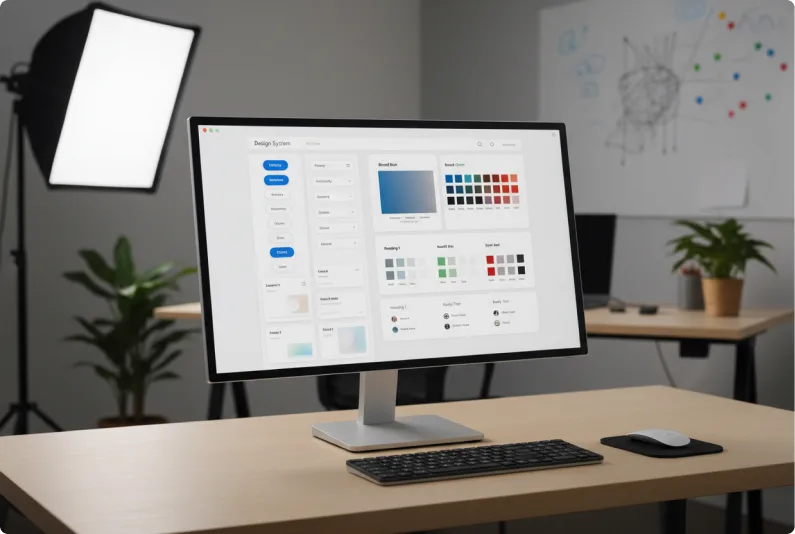
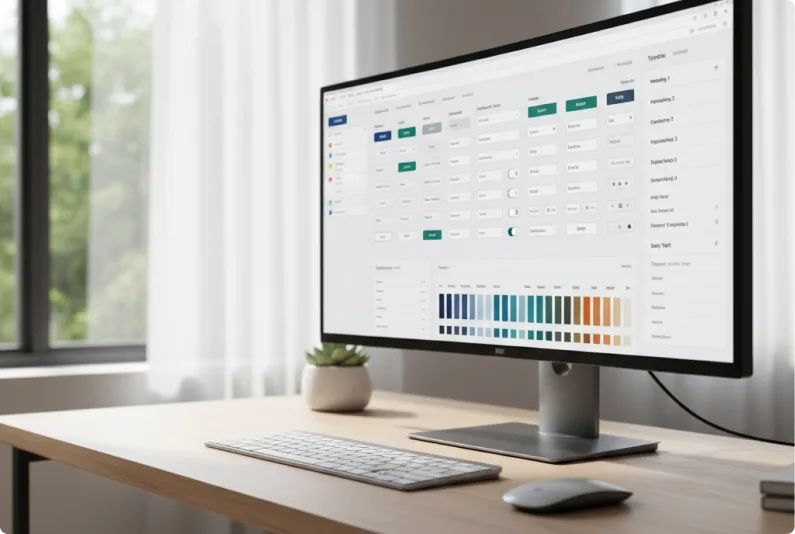
A design system earns its keep when engineers can build a new screen from it without waiting for a designer. That means design tokens for color, type, spacing and radius that match the variables in code, components named the same way in Figma and in the component library, and patterns for the problems that repeat: tables, filters, forms, uploads and notifications.
We document each component with the states it needs:
Starting small is fine. A first release needs a handful of well-built components far more than a hundred half-specified ones.
Handoff fails when design is thrown over a wall. A polished file arrives, engineers guess at the missing states and the shipped product drifts from what was approved. Because our designers and engineers sit in the same squad, handoff is a conversation that runs through the build rather than a single delivery.
In practice, each journey ships with annotated screens, interaction rules, validation and error copy, responsive behavior, and edge cases discussed with the engineer who will build them. Engineers review flows against implementation constraints before they are final, and a designer checks the built experience before release. The same team handles MVP development for startups, so product design services and delivery scope stay connected instead of being priced and planned apart.
Accessibility is cheaper to design in than to retrofit, so it is part of our product design services from the start. We plan against the Web Content Accessibility Guidelines (WCAG) from the first wireframe: sufficient color contrast, visible focus states, a logical keyboard order, labels and errors that screen readers announce, and touch targets that work on a phone. Where a product needs Arabic, we design right-to-left layouts properly rather than mirroring a finished English interface.
Accessible design also tends to be clearer design. Plain labels, predictable navigation and forms that explain their own errors help every user, including the ones in a hurry on a small screen.
Sign-up is not the finish line. SaaS products earn their place when people come back, so we design onboarding, empty states and re-entry points as carefully as the core screens. The aim is a short path to the first useful result and a clear reason to return. Our article on onboarding design for user activation goes deeper on the patterns.
Livespace.ai shows the value of designing around one moment. Designers productize their style, and homeowners see that style applied to their own space. The marketplace reached 2.8K users within three months.
Portfolios show finished screens. They rarely show whether the product worked. When you compare a product design agency, a freelancer or an in-house hire, ask questions that reveal how decisions get made:
The answers matter more than the visual style of past work. A team that designs with engineering in the room and stays for iteration usually ships something closer to what you approved. After the first release, our post-launch product iteration work picks up where launch leaves off.
Each option can work. The difference is how closely design stays tied to engineering and to what happens after release.
| Compared | Design-only agency | Freelance designer | Arcforth product squad |
|---|---|---|---|
| Research | Often a separate discovery phase | Depends on the individual | Observation and interviews before key flows are drawn |
| Engineering input | Usually after design sign-off | Usually none | Engineers review flows while they are designed |
| Design system | Often thorough, may not match the code | Varies by project | Tokens and components mapped to the codebase |
| Handoff | Files and a walkthrough | Files | Continuous through the build, built screens checked before release |
| After launch | A new engagement | Ad hoc | Iteration in weekly release cycles |

Simpler journeys for property discovery, viewings, applications and agreements.
View Viewings Case Study
An AI platform where designers productize their style and homeowners try it in their space.
View Livespace.ai Case Study
A tailored procurement platform spanning sourcing, RFQs and purchase orders.
View CollectiveSpend Case StudyMap the user roles, tasks and current friction, and agree the journey that matters most.
Prototype the riskiest journey and review it with available users before the build.
Deliver screens, states and a design system alongside engineering, then check the built experience.
Release, watch how people use the product and refine the points where they struggle.
A Product Pilot ($1,499 once) focuses on one workflow, core flows and prototype, build-ready requirements and an MVP roadmap. A Product Squad ($3,490 per month) supports ongoing product direction, design, engineering and iteration. An Embedded Product Unit (from $5,000 per month) adds capacity for larger products and multiple workstreams.
Design is part of every engagement rather than a separate line. A Product Pilot at $1,499 once covers one high-value workflow, core flows, a clickable prototype and build-ready requirements. Ongoing design and engineering run on a Product Squad at $3,490 per month.
Yes. We can focus on a specific journey, such as onboarding, property applications or procurement approvals, rather than redesigning the whole product.
They work in the same squad under the same product direction. Engineers review flows against implementation constraints while they are designed, and a designer checks the built experience before release.
User access makes research and validation far more useful. If access is limited, we identify what can still be tested and record the assumptions that need evidence later.
Yes. Designs, prototypes and the design system live in Figma, with components and tokens named to match the code so engineers can build from them directly.
Yes. We design against the WCAG guidelines from the first wireframe, covering contrast, keyboard access, focus order and screen reader labels, plus right-to-left layouts when a product needs Arabic.
A free clickable prototype is delivered within 48 hours once we have reviewed your request and agreed the scope. A Product Pilot then turns the core flows into build-ready requirements and an MVP roadmap.

If you have committed to a software venture and need a team to shape, build and keep improving it, start with a product conversation.
Human judgment. AI-native delivery. One team accountable from the first decision to every release.