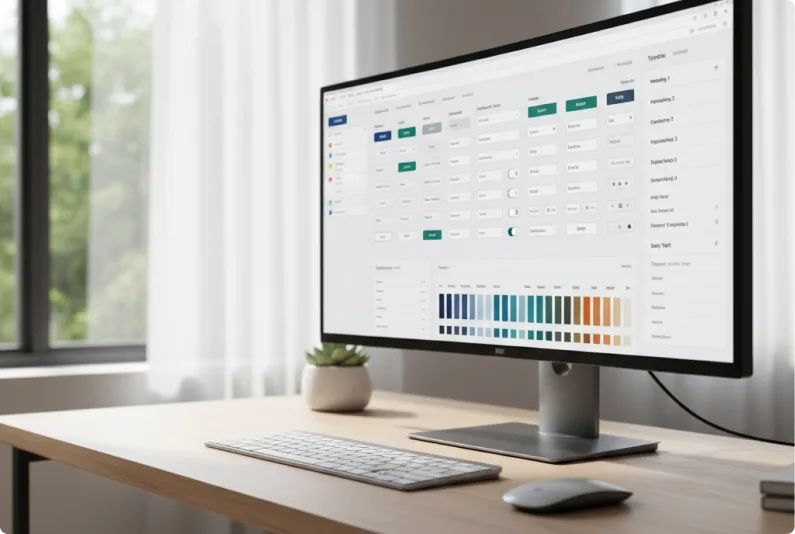
Keep one prioritized roadmap
Bring user feedback, commercial priorities and technical work into one queue. The next release becomes an explicit decision rather than a pile of disconnected requests.

Services
A dedicated product squad gives you senior product, UX, full-stack engineering and QA skills working as one team in weekly release cycles, without months of recruiting. Arcforth's Product Squad costs $3,490 per month. You bring the industry knowledge and commercial priorities; the squad turns them into product decisions, designs and working software you can put in front of customers.
Get a Free Product MapBring user feedback, commercial priorities and technical work into one queue. The next release becomes an explicit decision rather than a pile of disconnected requests.
Work through each workflow from product decision to release review. The squad owns the handoffs between disciplines and keeps requirements aligned as the product changes.
Review progress, decisions and working software every week. Short approval cycles surface trade-offs early and keep you involved where your industry judgment matters.
A dedicated product squad is a small, standing team that covers every discipline a product needs (product direction, UX and product design, full-stack engineering and QA) and works on your product continuously rather than project by project. It is accountable for what ships each week, not for hours logged.
The word dedicated matters. The same people stay on your product, learn your market and remember why a decision was made three months ago. That continuity is what most outsourced arrangements lose, and it is why you can review progress weekly instead of re-briefing a new contractor every sprint.
Arcforth's Product Squad is $3,490 per month. It suits founders and industry experts who have a product to grow, or a validated idea to build, and no in-house product team yet.
Early products rarely need four full-time specialists every single week. Some weeks are mostly design and user research; others are mostly back-end work, integrations or testing. A fractional product squad for startups is built for that reality: you get senior people across all four disciplines, and their time moves to wherever the roadmap needs it.
So fractional does not mean part-time attention or a rotating cast. The squad is dedicated to your product in the ways that matter: one roadmap, one weekly rhythm and shared context that builds over time. What you are not paying for is four full-time salaries during the weeks when one discipline has little to do.
When the product outgrows that shape, with several workstreams at once or a much larger codebase, the Embedded Product Unit adds capacity from $5,000 per month, including dedicated forward deployed engineers.
A squad works best when the problem is clear enough to build and the product needs steady, well-judged progress rather than a one-off delivery. The typical moments to hire a dedicated product team:
If you are comparing this with technical leadership on its own, our guide to CTO as a service for startups sets out where an advisor is enough and where you need a team that also builds.
We would rather say this before you sign than after. A dedicated product squad is the wrong fit when:
Each cycle starts with priorities: what you learned from customers, what usage shows, and what the squad recommends next. Work is cut small enough to ship within the cycle, then designed, built and tested by the same team and reviewed with you as working software rather than slides.
Releasing every week only works if releases are boring. We keep changes small, run automated checks on every change and use feature flags to separate deploying code from switching it on. The details are in how we ship weekly without breaking production.
On budget, a monthly squad replaces a large up-front quote, which assumes the plan will not change, with a predictable monthly cost. If you are still sizing a first build, our breakdown of how much it costs to build an MVP compares the common options.
You own the why: the market, the customers, the commercial priorities and the final call. The squad owns the how: turning those priorities into product decisions, designs, a release plan and working software, with the reasoning written down so it survives team changes and future hires.
In practice that means one prioritized roadmap you can read at any time, agreed approval points for anything that affects customers or money, and a squad that pushes back when a request would cost more than it returns. A team that never says no is not managing your roadmap. It is taking orders.
Skalix AI, an AI-native revenue platform with voice agents, web chat, multi-channel follow-up, CRM sync and human handoff, went from build to launch in four weeks. Products like that are never finished at launch: each channel adds integration work and each customer conversation surfaces a new edge case, which is the steady, cross-discipline work a squad is designed to absorb.
CollectiveSpend runs procurement for UAE enterprise users, from sourcing and multi-supplier RFQs to purchase orders and approvals, and more than $3B in spend is managed through it. JoinClan went from idea to MVP in three weeks, turning short weekly voice conversations into editor-shaped posts for LinkedIn and X. Different markets, same pattern: a founder with deep domain knowledge, and one team responsible for turning it into releases.
Most squads start from one of two places. If you have a live product or a validated scope, we agree priorities, decision owners and boundaries, then begin the first weekly cycle. If you are earlier, a Product Pilot or a free clickable prototype comes first, so the squad builds on evidence rather than assumptions.
For a heavier engineering build, see how we work as a software product development company. Once you are live, post-launch product iteration covers how the squad turns real usage into the next release.
How the common ways to staff a product compare for an early-stage company. In-house costs vary widely by market and seniority, so they are described rather than priced.
| Compared | Arcforth Product Squad | Hiring in-house | Freelancers | Traditional agency |
|---|---|---|---|---|
| Roles covered | Product, UX, full-stack engineering and QA in one team | Whatever you can recruit, with each role a separate hire | Usually one discipline per person, and you assemble the team | Often all four, split across departments with an account manager in between |
| Time to start | Once priorities and scope are agreed, with no recruiting | Months of recruiting per senior role, then onboarding | Quick for one person, slower to assemble a team that works well together | Sales, discovery and a statement of work before the build begins |
| Commitment | Monthly engagement, with the Embedded Product Unit when you need more capacity | Long-term employment, notice periods and usually equity | Per task or hourly, easy to stop but hard to keep continuity | Fixed-scope project contracts or long retainers |
| Who owns the roadmap | You set priorities, and the squad turns them into product decisions and a release plan | You, once you have hired a product lead | You, entirely | Often the statement of work, changed through change requests |
| Quality assurance | Built into every weekly release | Only if you hire for it | Usually left to you | Varies, sometimes a separate phase at the end |
| Cost model | $3,490 per month for the whole squad | Salaries for each role plus recruiting fees, benefits, equipment and management time | Hourly or per-task rates for each person, plus your coordination time | Project quotes or hourly rates, with scope changes billed on top |

An AI-native revenue platform for calls, chat and customer follow-up.
View Skalix AI Case Study
A tailored procurement platform spanning sourcing, RFQs and purchase orders.
View CollectiveSpend Case Study
Short weekly conversations turned into consistent, editor-shaped content.
View JoinClan Case StudyAgree the product priorities, decision owners and delivery boundaries.
Resolve the highest-risk assumptions before expanding the work.
Design, engineer and test through a shared roadmap and weekly reviews.
Release regularly and feed actual use into the next priorities.
A Product Pilot ($1,499 once) focuses on one workflow, core flows and prototype, build-ready requirements and an MVP roadmap. A Product Squad ($3,490 per month) supports ongoing product direction, design, engineering and iteration. An Embedded Product Unit (from $5,000 per month) adds capacity for larger products and multiple workstreams.
At $3,490 per month you get a dedicated cross-functional squad covering product direction, UX and product design, full-stack and AI engineering, and QA, working in weekly release cycles with roadmap ownership and weekly reviews.
You get senior people across product, UX, engineering and QA without paying four full-time salaries. Their time shifts to where your roadmap needs it each week, while the roadmap and context stay dedicated to your product.
The Embedded Product Unit starts from $5,000 per month and suits larger products, multiple workstreams or deeper delivery capacity, with dedicated forward deployed engineers. Scope and responsibilities are agreed around the product.
The founder brings market context and business priorities. Arcforth turns those inputs into product decisions and a delivery roadmap, with review and approval points agreed together.
When the idea is untested, when you already have product and engineering leadership and only need extra hands, when the work is a one-off project, or when nobody on your side can make decisions each week. We will tell you before you sign.
Yes. The squad writes decisions down and keeps documentation and tests current, so a future in-house team can take over the product or work alongside the squad.

If you have committed to a software venture and need a team to shape, build and keep improving it, start with a product conversation.
Human judgment. AI-native delivery. One team accountable from the first decision to every release.