01 - Review the Whole Workflow, Not Just the Hosting Region
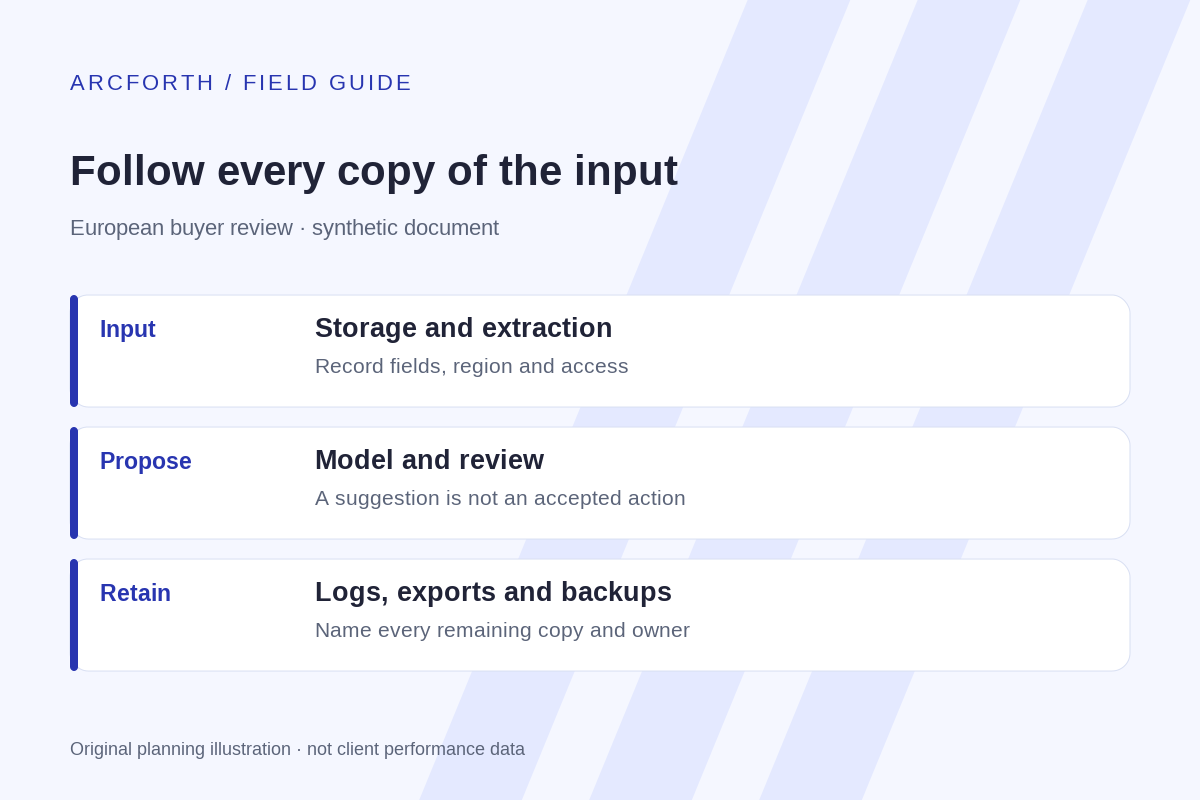
An AI product development proposal for a European team should show what happens to the input after a user submits it. The main application may use a selected region while logs, model calls, support tools or exported files follow other paths. A region label alone cannot explain the whole workflow.
This guide is an engineering evidence exercise for teams evaluating a product partner. Use a fictional supplier-document assistant: a buyer submits a document, the application extracts fields, a model drafts an explanation, and a reviewer decides what enters the procurement record. Keep the model’s proposal separate from the accepted business action.
Arcforth’s CollectiveSpend case is UAE procurement work, not an EU reference or evidence that this fictional AI feature was implemented. Its buyer and supplier roles provide useful context for the boundary being reviewed.
02 - Follow One Synthetic Document Through Six Places
Prepare a synthetic file with a unique marker and no real supplier or personal information. Record the input store, extraction step, model request, application log, review queue and output destination. At every step, ask what is copied, who can access it and how it is removed.
| Place | Evidence to request | Question that stays open until answered |
|---|---|---|
| Input storage | Region, access rule and deletion behaviour | Are versions and backups retained separately? |
| Extraction or model provider | Exact service and data fields sent | Are retention settings documented for this account? |
| Application logs | Redacted sample with synthetic marker | Can raw document content enter an error log? |
| Support access | Role and audited support action | Who can inspect the document during an incident? |
| Review queue | Proposed versus accepted state | Can a model response change a record without review? |
| Export or downstream system | Destination and owner | Does deletion here require another workflow? |
A screenshot of a settings page is one piece of evidence. Pair it with the account, service and environment to which it applies. Unknown retention or support access is an unresolved decision, not a blank cell to interpret as no retention or no access.
03 - Keep Technical Evidence and Legal Approval Distinct
The EDPB guide distinguishes controllers, processors and subprocessors and explains the role of documented processing arrangements. Have your organisation’s responsible advisers establish the applicable roles, contracts and transfer requirements for the actual processing.
The engineering team supplies the data-flow register, access boundaries, provider settings and test evidence needed for that review. This worksheet is not a compliance certificate or a conclusion that a particular deployment satisfies the GDPR. Do not infer an EU establishment, EU-only engineering access or approved international transfers from an English-language service page.
Download the AI vendor data-flow review worksheet. Record the exact provider and account scope privately, with evidence references and decision owners. Keep credential values and production documents out of the public worksheet.
04 - Rehearse Access, Failure and Deletion
Use two fictional organisations. A user in organisation A uploads the synthetic document; an organisation B account must not retrieve it through the interface, direct record request or export. Test the server boundary with authorised test accounts, not only whether the navigation hides the link.
Interrupt extraction and model responses in the approved test environment. The user should see a recoverable state, and the operator should have enough redacted evidence to investigate. A retry must not create an unreviewed duplicate business action. Define who can retry, correct or close the item.
Delete the synthetic input through the agreed workflow, then inspect the stores the test is meant to cover. Record any separate backup lifecycle, log retention or provider deletion process. An absent UI record does not prove every copy has been removed. Verify only the paths you actually tested and keep remaining paths visible.
05 - Agree What the AI May Propose and Change
For the supplier-document example, give the model read access only to the fields required for its task. Have it return a proposed explanation and evidence reference. The reviewer can accept or correct the proposal through a separate authorised action. Keep the original extraction, proposed result and accepted change distinguishable.
Add examples of incomplete fields, conflicting amounts and unsupported claims to the evaluation set. Define when the system should ask a question or decline to propose a result. Use the same examples before changing a provider or prompt so a plausible-looking answer is not mistaken for a verified improvement.
Our LLM feature evaluation guide develops the quality checks. The AI document-workflow service explains the product and engineering work around extraction, review and operational exceptions.
06 - Choose a Partner Against the Evidence They Can Provide
Ask each proposed team to show a comparable workflow, their required access, a safe test plan, the operating owner and the items awaiting business or legal review. Agree the first European market, product language, time zone and response window; Europe is not a single local operating context.
Review product development for European teams for Arcforth’s remote delivery arrangements. Bring a safe workflow outline, proposed providers and the unresolved boundary to scope the AI data-flow review. The first engagement should make the evidence and remaining decisions explicit before production access is granted.
Frequently Asked Questions
Does EU hosting prove the whole AI workflow stays in Europe?
No. Inspect model requests, logs, support access, exports and backups as separate paths, with the actual service, account settings and responsible owners.
Is the worksheet a GDPR compliance checklist?
It records engineering evidence for the responsible advisers to review. It does not certify compliance or decide the legal roles or transfer requirements for a deployment.
Should we use real supplier documents in the first test?
Use synthetic inputs for the described rehearsal. Any later production access needs its own authorised scope and agreed handling arrangements.
Make the data boundary reviewable.
Bring a synthetic input, proposed providers and the unresolved access or retention path. Define the evidence needed before production access.
The design, engineering, and product research collective at Arcforth building tomorrow's category-defining digital products.