01 - Turn the Funding Milestone Into a Release Decision
For a funded US startup, more engineering capacity is useful only when somebody owns the release it is meant to deliver. Start with the customer commitment or product problem behind the hiring request. Funding itself does not establish product fit, a clear backlog or a reliable operating process.
This guide uses a fictional B2B wholesale release to compare three choices: an internal hire, an embedded engineer and a product squad. It is a responsibility exercise, not a recommendation that every funded company should outsource. Your existing team, runway, hiring process and customer commitments determine the fit.
Organic Soda Pops is Arcforth’s published US wholesale marketplace example, with ordering by the case and vendor operations. JoinClan is separate US content-workflow work. Neither case is presented here as evidence that a client raised funding or achieved a claimed revenue outcome.
02 - Name the Gap Before Choosing the Team Model
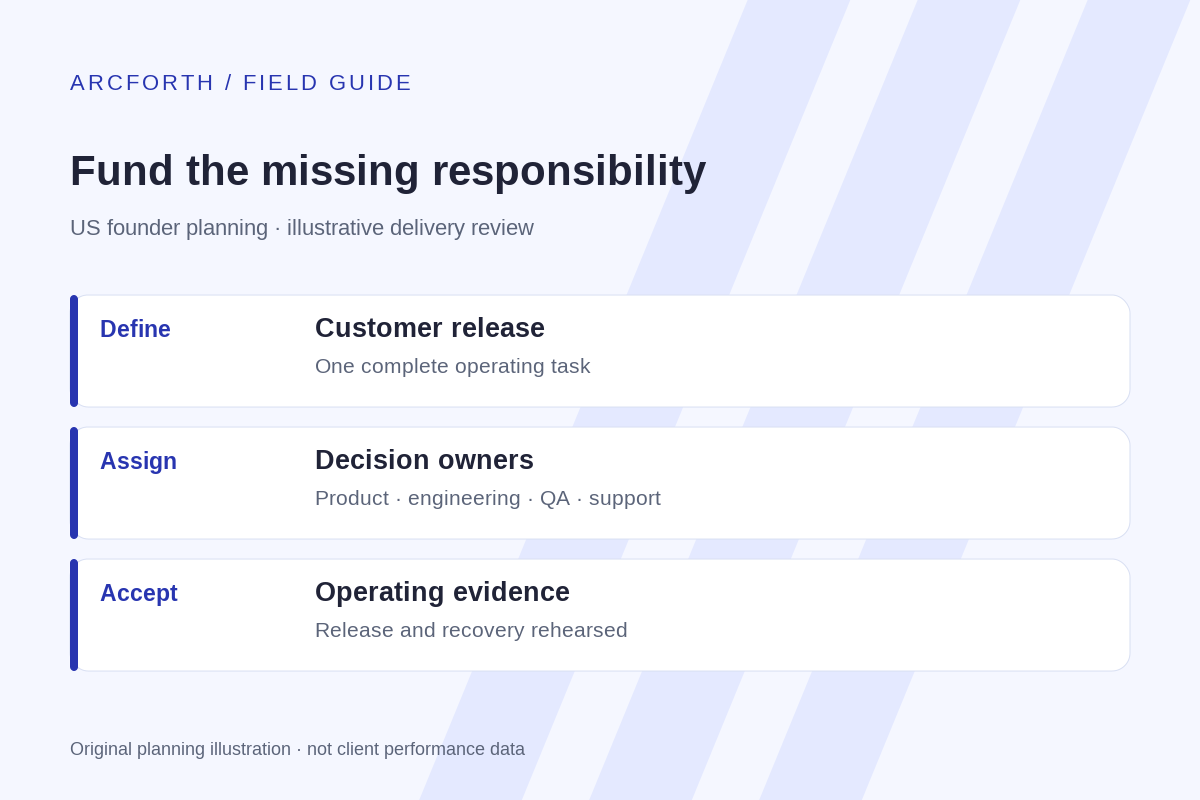
Write the first release as one operating task: a retail buyer orders a case from an approved vendor and the operations team can reconcile the outcome. Then assign product decisions, design, engineering, QA, release approval and support.
| Responsibility gap | Model to evaluate | What the founder still must own |
|---|---|---|
| Clear backlog; technical lead needs capacity | Embedded engineer | Priorities, review process and release decisions |
| Workflow and design unresolved; release owner missing | Product squad | Customer access and commercial decisions |
| Long-term capability requires internal ownership | Internal hiring plus transition plan | Hiring, onboarding and management |
| Working demo; unknown production dependencies | Bounded technical assessment first | Access and decision on findings |
A small team with product decisions missing may not benefit from adding the same role repeatedly. A strong internal product and engineering lead may need one specific skill rather than a separate product organisation. The US startup delivery worksheet makes these responsibilities visible before the engagement is priced.
03 - Use a Release With Three Observable Acceptance Gates
For the fictional wholesale release, gate one is a correct order: the buyer sees the case quantity, vendor and full stated charge before confirmation. Gate two is a recoverable transaction: a delayed provider response does not create an unintended duplicate order. Gate three is an operable release: support can trace a failed order to its state and next authorised action.
Ask the proposed team to identify which gate has an unresolved dependency. Vendor payout configuration, a shipping provider or finance policy may require a separate owner. A demonstration using mock services proves a different thing from an accepted integration in an approved environment.
Keep the acceptance record close to the work: release commit, test results, relevant screen, exception and named reviewer. A list of tickets closed is useful delivery activity, but it cannot substitute for the customer completing the agreed task.
04 - Compare a Planning Window Without Inventing a Hiring ROI
Use your own hiring, onboarding and team-availability assumptions. Compare the same planning window, included responsibilities and required release, then identify what remains outside each option. Do not compare a full-time employee’s headline salary with a supplier’s monthly fee as if their responsibilities and capacity were identical.
For illustration, a six-week planning window might contain a one-week dependency review, three weeks of implementation and two weeks for pilot operation and corrections. That is a scenario to challenge, not an Arcforth timeline commitment. Integration access or customer availability can change it before any code is written.
Agree actual Eastern, Central or Pacific review windows and escalation contacts. Record the time zone by name and account for seasonal changes. A remote engagement needs explicit overlap, not an assumption that every engineer is available throughout US business hours.
05 - Protect the Release as the Team Grows
Keep source, environments and provider accounts under the agreed business ownership model. Define review responsibilities, required checks and who may release or revert a change. GitHub documents branch protections and required checks; configure them for your actual repository and plan rather than treating the presence of a pull request as a complete control.
Have the next authorised engineer build and deploy the agreed release in a non-production environment. Preserve architecture decisions and unresolved risks with the product. A supplier should be evaluated partly on whether the eventual internal team can understand and operate the work.
The technical handover rehearsal provides an account and recovery checklist. Its UK review context differs, but the engineering evidence can be adapted to a US team’s systems and working arrangements.
06 - Choose the Smallest Engagement That Covers the Gap
If you retain a technical owner and need delivery capacity, review embedded engineering for US teams. If strategy, design, implementation and QA need to work together around a first release, review US startup product development and the product squad model.
Bring the release commitment, current team, unknown dependency and decision window to scope your product delivery gap. Do not send an investor data room or confidential customer export. A safe workflow outline is enough to begin assessing fit.
Frequently Asked Questions
Should a funded startup hire or use a product squad?
Name the missing responsibilities first. Embedded capacity fits an existing technical owner; a squad can connect product, design, engineering and QA; internal hiring builds longer-term capability. Compare the same release and period.
Is the six-week example a delivery promise?
No. It is an illustrative planning window that must be challenged against integration access, existing code, people and pilot availability.
Do the US cases establish funding or revenue results?
No. They show relevant product work. This guide does not claim funding, revenue or growth results for those clients.
Fill the missing delivery responsibility.
Bring your existing team, first release and unresolved dependency. Compare a squad, embedded capacity and hiring against those responsibilities.
The design, engineering, and product research collective at Arcforth building tomorrow's category-defining digital products.