01 - Decide Which Responsibility You Need Covered
To decide how to choose a technical partner, write down the work you need someone to own. Is it choosing the architecture, deciding the first product scope, designing the workflows, implementing a backlog, or operating the product after launch? These require different kinds of support.
A fractional CTO or technical advisor can review decisions and guide a team. A product delivery partner brings people who also design, build and test. A technical co-founder takes on a founder role with company-level responsibilities and an agreed equity arrangement. Ask each candidate to describe their actual role in your first release.
For an industry founder, a practical brief is one page: who the first users are, how they work today, what is painful, what a useful first outcome looks like and which decisions you can make yourself. That gives everyone the same problem to respond to.
02 - Ask for Evidence You Can Inspect
Start with a relevant product and ask the candidate to walk through one workflow. Ask what their team owned, what existed before they joined and which decisions they made. A screen recording, live walkthrough or case study can show more than a list of technologies.
When reviewing a reference, ask about the working relationship as well as the launch. Who explained trade-offs? How were changes handled? What happened when something failed? Did the client have access to the code and infrastructure? How easy was it to continue after the original build?
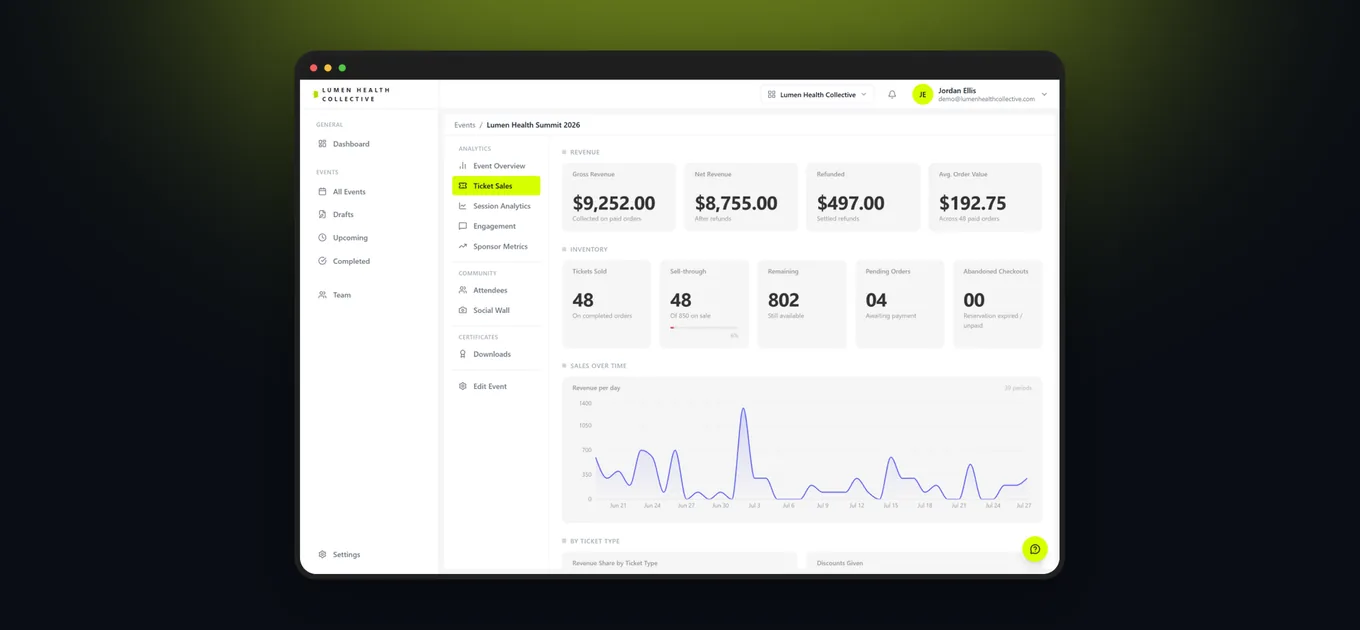
Look for a clear connection between the evidence and your problem. An event platform such as Mesmeride raises questions about check-in and on-site operations. A procurement product such as CollectiveSpend raises questions about approvals, supplier data and audit history. Use the workflow to guide the conversation.
Check that the evidence proves the task you need.
A QR code is a useful example. Mesmeride’s published attendee badge says “scan to connect”. It demonstrates a networking journey. A founder commissioning ticket admission still needs evidence of ticket eligibility, staff permissions and duplicate-scan handling. A familiar-looking screen can be relevant without proving the same workflow. Inspect the badge walkthrough, then record the admission evidence you would still need.
Apply that distinction to AI work too. The Skalix conversation walkthrough shows a summary beside its recording and transcript; it does not by itself establish a particular CRM connector or latency. The Livespace room-design journey connects discovery to a try-on; representative-room testing is still needed for your own quality target.
Use the technical partner evidence brief during candidate conversations. Its rows ask for an observation, supporting reference, owner and next action. They start blank: this is your decision record, not an Arcforth rating of any supplier.
03 - Use the Same Questions for Every Candidate
A structured conversation makes proposals easier to compare. Record the answer, the evidence offered and anything still unresolved. Use these questions in the first serious discussion.
- Who will work on the product? Ask for roles, responsibilities, availability and who remains accountable when a team member changes.
- How will you choose the first release? Ask what they need to learn from users and which assumptions they would test before engineering.
- What can we review each week? Ask to see an example of a progress update, demonstration or decision record.
- How will we accept the work? Ask how acceptance criteria, testing and release approval are agreed.
- What could change the budget? Ask about integrations, data migration, external approvals, usage costs and changing requirements.
- Who owns and can access the accounts? Cover the repository, cloud hosting, domain, payment services, analytics and third-party APIs.
- How are production issues handled? Ask about monitoring, incident ownership, response expectations and what support is included.
- How does a handover work? Ask which documents, access and walkthroughs an incoming team would receive.
04 - Compare Proposals Against a Shared Workflow
Give each candidate the same example. For a property product, that might be a buyer submitting documents, an agent reviewing them and both sides tracking the next step. Include an exception, such as a missing document or a rejected submission. Ask each team to explain the proposed first release.
Compare the boundaries and assumptions as carefully as the price. One proposal may include design, QA and deployment while another covers implementation alone. A low headline price tells you little until you know who owns the remaining work.
| Area | What to record |
|---|---|
| Scope | Users, included workflow, exceptions and explicit exclusions |
| Delivery | Named roles, review rhythm, acceptance criteria and approval owner |
| Dependencies | Data access, third-party services and decisions needed from your team |
| Total cost | Build fees, hosting, usage charges, maintenance and change process |
| Continuity | Ownership terms, account access, documentation and transition support |
If you are still working out the size of the build, our MVP cost guide explains the choices that affect it.
05 - Agree the First Decision Point
A first engagement should produce something you can use to decide what happens next. That might be a tested prototype, an integration assessment or a working slice of the product. State the uncertainty it addresses and how you will review the result.
For a prototype, agree the workflow, who will test it and which responses matter. For an integration assessment, agree the external system, access needed, supported operations and failure cases. For a working release, agree its acceptance criteria, test environment and deployment responsibilities.
This keeps the next commitment grounded in evidence. Our prototype and MVP comparison explains what each can validate. A prototype can test comprehension and flow; a live product is needed to observe real use and operating behavior.
06 - Put Access and Continuity Into the Agreement
Write down who owns project work and when ownership transfers. Identify third-party components and licenses. Agree who creates and controls the repository, cloud accounts, domain, payment provider and other operational services.
Ask for a handover checklist before the engagement begins. It should include how to run and deploy the product, environment configuration, integrations, data ownership, important architecture decisions and outstanding issues. Agree how credentials are transferred securely and how access is removed when people leave.
Support also needs a boundary. Define how issues are reported, who responds, what is covered and how additional work is agreed. Review these terms with an appropriate adviser when finalizing your contract.
07 - Make the Decision With the People Doing the Work
Meet the person responsible for product decisions and the person responsible for engineering. Walk them through a difficult example from your industry. Listen for clarifying questions, explained trade-offs and a concrete next step. Those are useful signals about how the working relationship may feel.
If you are deciding how to choose a technical partner, start with five questions: what happens first, who is accountable, what you can inspect, what it costs and how you can continue with another team. If an answer is missing, resolve it in writing.
Arcforth works as a technical partner for startups, connecting product strategy, UX, engineering and QA. If that matches the responsibilities you need covered, bring one workflow to a product conversation and we can work through an appropriate starting point.
Frequently Asked Questions
How do I evaluate a technical partner if I cannot review code?
Ask for a walkthrough of a relevant workflow, clear responsibilities, acceptance criteria and examples of progress reviews. Speak with a client reference about delivery and support. For a significant existing codebase, consider an independent technical review as part of due diligence.
Should I hire a technical co-founder or a development partner?
Begin with the responsibilities you need covered. A co-founder shares company-level leadership with an agreed equity arrangement. A development partner provides defined product and engineering work through a paid engagement. The appropriate choice depends on the long-term role and the immediate delivery work.
What should a first technical-partner engagement produce?
It should resolve a named uncertainty and leave a reviewable result, such as a tested prototype, an integration assessment or an accepted working release. Agree the scope, acceptance criteria, cost and next decision point before starting.
Compare a partner against your actual product.
Bring the first user journey, current product and decisions you need help owning. Discuss product direction, design, engineering and release as an agreed scope.
Co-founder at Arcforth. Leading venture strategy, MVP scoping, product validation, and growth loops for early-stage startups.