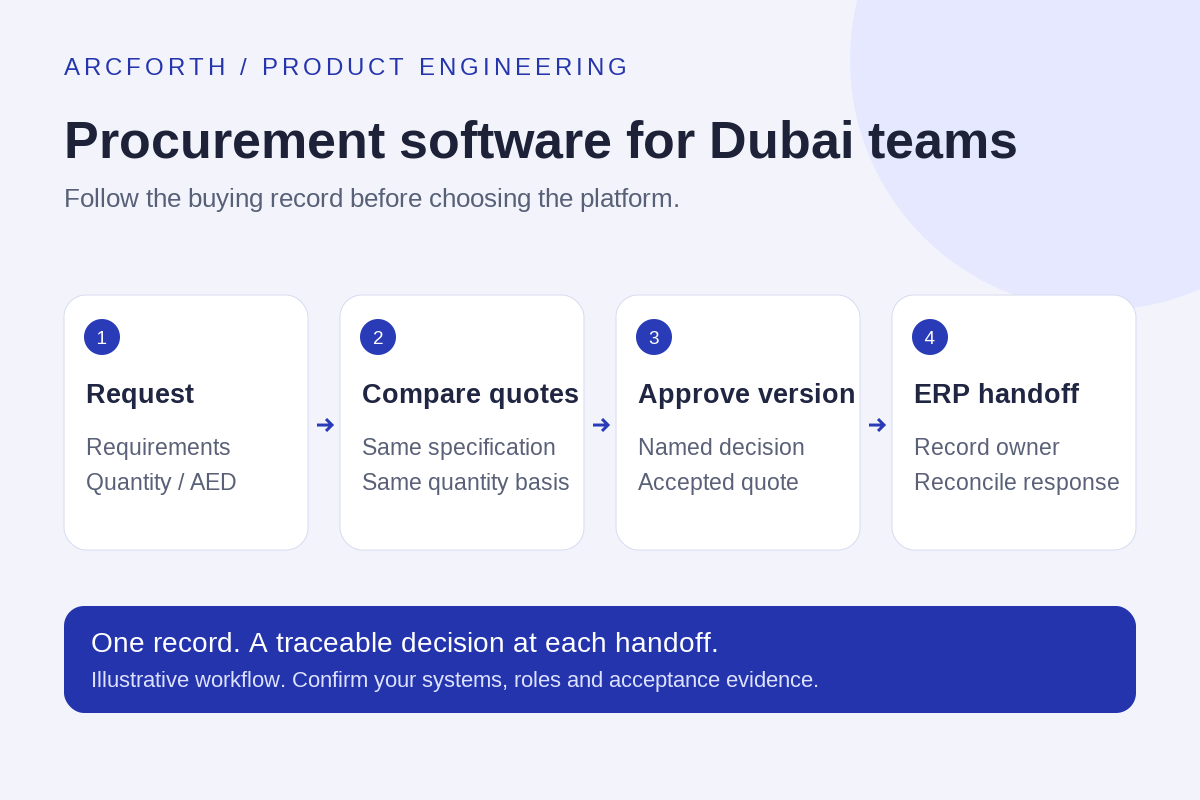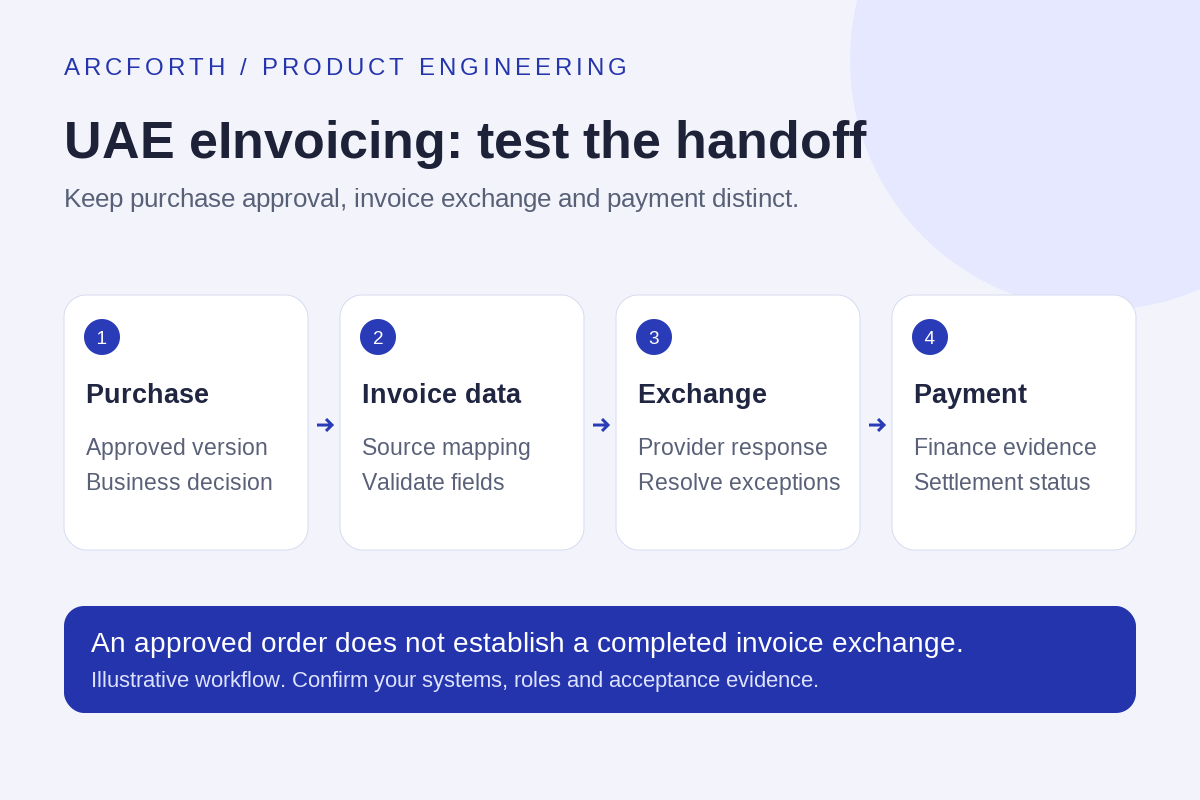
01 - The Invoice Is a Separate Handoff
A purchase request can be approved while the invoice exchange is still incomplete. For UAE eInvoicing work in a procurement product, those states need different evidence and different owners. The useful question is where your software creates, receives or matches invoice data, and how it will know that the next system accepted it.
The UAE Ministry of Finance describes an eInvoice as structured invoice data exchanged electronically and reported to the Federal Tax Authority; a PDF or scan alone is not that exchange. Its official programme portal is the source for current provider and programme information. This article addresses the engineering handoff, with your finance owner and selected provider confirming the requirements for your business.
First establish your role: does your product issue invoice data, receive it on the buyer side, or only connect procurement records to another finance system? A procurement platform is not automatically the invoice issuer or the accredited exchange provider.
02 - Use the Current Rollout as a Planning Trigger
As reviewed on 22 November 2026, Ministerial Decision 66 of 2026 specifies implementation by 1 January 2027 for persons subject to the system with revenue of at least AED 50 million. Its provider-appointment deadline precedes this article. The relevant finance or tax owner should confirm your cohort, exclusions and current obligations from the Ministry’s legislation before you set the release plan.
The Ministry’s 26 October 2026 guidelines, version 2.0, provide the wider phased rollout and preparation context. Use the current sources rather than a copied deadline table. We are treating this as a dated implementation-planning signal, not evidence of a measured search surge or a claim that every Dubai business has the same deadline.
Turn the planning discussion into three concrete decisions: which invoice journey is in scope, which system supplies the authoritative data, and who can verify a completed exchange. A new dashboard is not the same deliverable as a tested handoff.
03 - Separate Four Decisions in Your State Model
For an illustrative buyer workflow, keep the business decision, data validation, exchange response and payment state separate. The labels below are suggested internal states; map them to the actual statuses and evidence returned by your selected systems.
| Internal question | Evidence to agree | Do not infer |
|---|---|---|
| Was the purchase approved? | The accepted quote or order version and business approver | That an invoice was exchanged |
| Was the invoice data accepted for this handoff? | The provider’s actual validation response and mapped record | That a transport response proves every business decision |
| What happened to the exchange? | The documented response or acknowledgement for this integration | That an unresolved timeout is a confirmed failure or success |
| Was payment settled? | The finance or payment system’s agreed evidence | That invoice acceptance means the supplier was paid |
Ask the reviewer to trace one reference across the workflow. If every screen uses a different identifier and nobody owns the mapping, an attractive status badge will not help the operator reconcile an exception.
04 - Map the Record Before Building the Connector
List the records your application owns and the records it consumes. For each candidate field, record the source, transformation, reviewer and destination. The provider’s current mandatory-field and API specifications should determine the actual mapping; this article does not invent a universal payload.
- Party identity: identify which system owns the supplier and buyer records and who confirms the identifiers required for this scenario.
- Invoice reference and version: distinguish a new record from a correction or another event about the same record.
- Commercial context: preserve the connection to the approved request, quote or order where your workflow needs it.
- Amounts and currency: identify the authoritative calculation and review process; avoid silently recomputing a tax decision in an unrelated service.
- Provider references: retain the identifiers your integration needs to trace responses and reconcile an unresolved exchange.
An AI extraction step may help propose fields from a document, but it should not silently turn uncertain text into an authoritative supplier identity or amount. Show the source and give the responsible reviewer a way to resolve the uncertainty.
05 - Test the Exceptions Before the Happy-Path Demonstration
Agree these example cases with the business owner and provider. They are engineering tests to adapt, not a substitute for provider conformance checks.
- A required field is missing or fails the provider’s validation. The responsible person can see the reason and correct the right source record.
- The same callback or delivery attempt arrives twice. The intended business action and recorded state do not duplicate.
- A connection times out after submission. The record remains unresolved until the agreed status lookup or reconciliation establishes what happened.
- A correction or credit-note journey is required. The reviewer can trace its relationship to the original record using the actual agreed workflow.
- A user outside the permitted role attempts to inspect or change an invoice. The agreed access boundary is enforced.
- A provider is unavailable. The team can explain the holding state, escalation owner and recovery procedure.
Capture observed results against a named system version and configuration. A screenshot alone does not establish a working integration; preserve the references and responses that let another person repeat the test.
06 - Agree What Your Provider and Product Team Each Own
Use the Ministry’s current accredited-provider information when choosing an exchange partner. Arcforth’s role in a proposed engagement is product and integration engineering; provider appointment, tax scope and acceptance responsibilities need to be explicit.
Your finance owner confirms the business and tax decisions. The selected provider supplies its supported onboarding, formats, validation and exchange interfaces. The product team owns the implementation and tests agreed in its proposal. Your operating team needs access to records, exception queues and deployment or recovery instructions.
Before pricing work, confirm test-environment access, documentation, credentials ownership, provider limits and fees, operating responsibilities and who signs off the handoff. These are dependencies to resolve, rather than unknown work to price as zero.
07 - Take One Handoff Into the Scoping Conversation
Download the UAE eInvoicing integration brief. Use its questions to name the record owner, provider mapping, acceptance evidence, unresolved dependency and decision owner for the first workflow. The blank fields are yours to complete; the brief contains no real invoice or taxpayer data.
For relevant procurement product interfaces, inspect our CollectiveSpend case and the Dubai procurement build walkthrough. Those show product context, not evidence of an accredited eInvoicing service or a completed connector to your provider.
Review our integration development service and procurement software development, then discuss the handoff your team needs to implement. Use the delivery-model comparison to assign implementation and operating responsibilities. Keep live credentials and customer invoices out of the first enquiry.
Frequently Asked Questions
Does uploading a supplier PDF complete UAE eInvoicing?
No. The Ministry distinguishes structured electronic invoice exchange and reporting from unstructured PDFs or scans. Map the actual data, provider interface and evidence required for your business scenario.
Does every procurement product have to issue the invoice?
First establish the role of your system. It may issue data, receive it as the buyer or match procurement records to an existing finance system. Agree the applicable duties and integration boundary with your finance owner and selected provider.
Is Arcforth the accredited eInvoicing provider?
The service described here is product and integration engineering. Choose and verify an accredited provider through the Ministry’s current information, then define the engineering scope and acceptance evidence around its supported interfaces.
What should we bring to an integration review?
Bring the first invoice journey, its record owner, the selected provider and available technical documentation, a safe test environment and the person who can accept the work. Use the downloadable brief to keep unresolved dependencies visible.
Scope the invoice handoff with its owners.
Bring your finance owner, selected provider, current system and available technical documentation. Agree the first integration and how its result will be verified.
The design, engineering, and product research collective at Arcforth building tomorrow's category-defining digital products.