Upload a room with context
Capture the room, requested changes and fixed features. Show an actionable response for an unsuitable image before spending a generation attempt.

Services
A room visualiser has to do more than produce an attractive picture. Arcforth builds the upload, style selection, generation, review and saved-result journeys around what your customer is trying to change. Our Livespace.ai work provides a UAE product example you can inspect before scoping your own app.
Capture the room, requested changes and fixed features. Show an actionable response for an unsuitable image before spending a generation attempt.
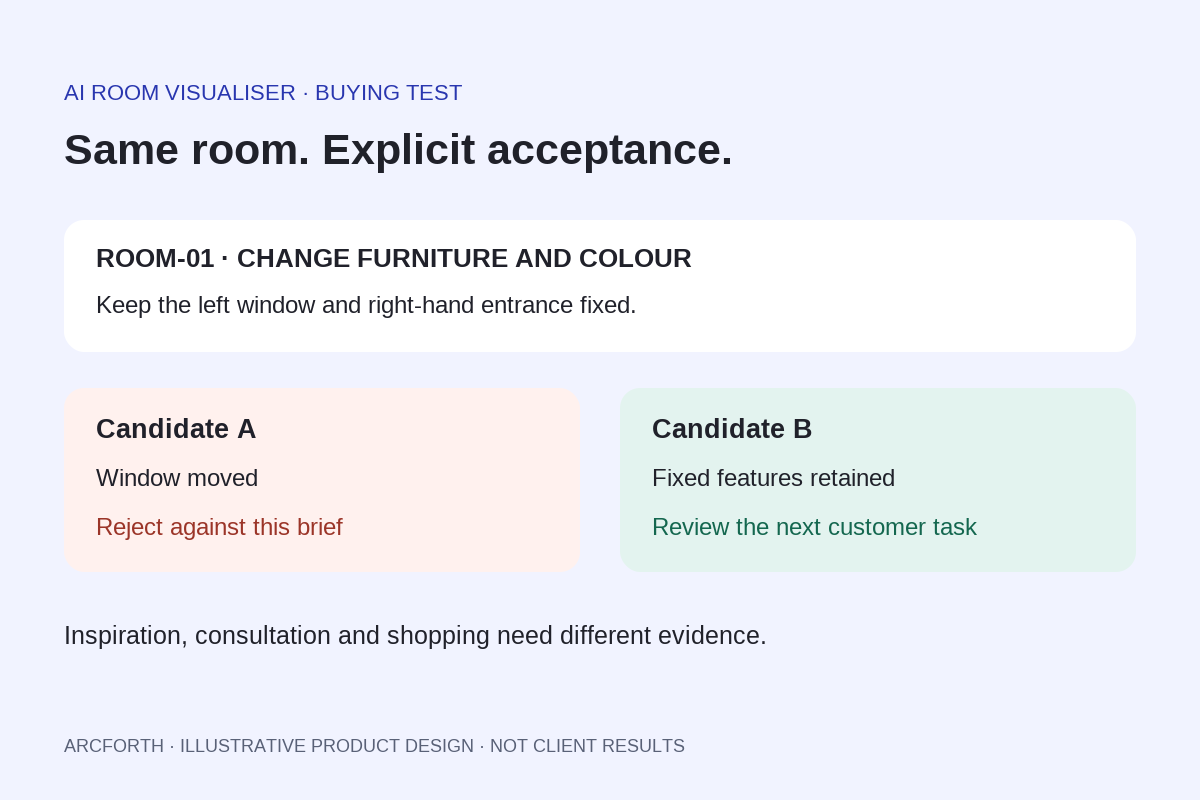
Keep the selected style and room version attached to the result. Let the reviewer reject a moved doorway or an unusable layout even when the image looks convincing.
Retain the approved output under the product’s access and retention rules. Separate inspiration from a verified product recommendation or a designer-approved plan.
An inspiration tool, a designer marketplace and a furniture-shopping product are different builds. The inspiration tool helps someone explore a look. The marketplace connects a designer’s work with an audience. The shopping product must connect an image to real catalogue records, availability and a buying action. Pick the promise that matters to the first customer before estimating the model integration.
For an illustrative Dubai design business, the first release might let a homeowner try one authorised designer style on a living-room photo and save a comparison for a consultation. Exact furniture matching, measured floor plans, checkout and a full creator payout system can stay outside that release. These are proposed scope choices, not a description of a client deployment.
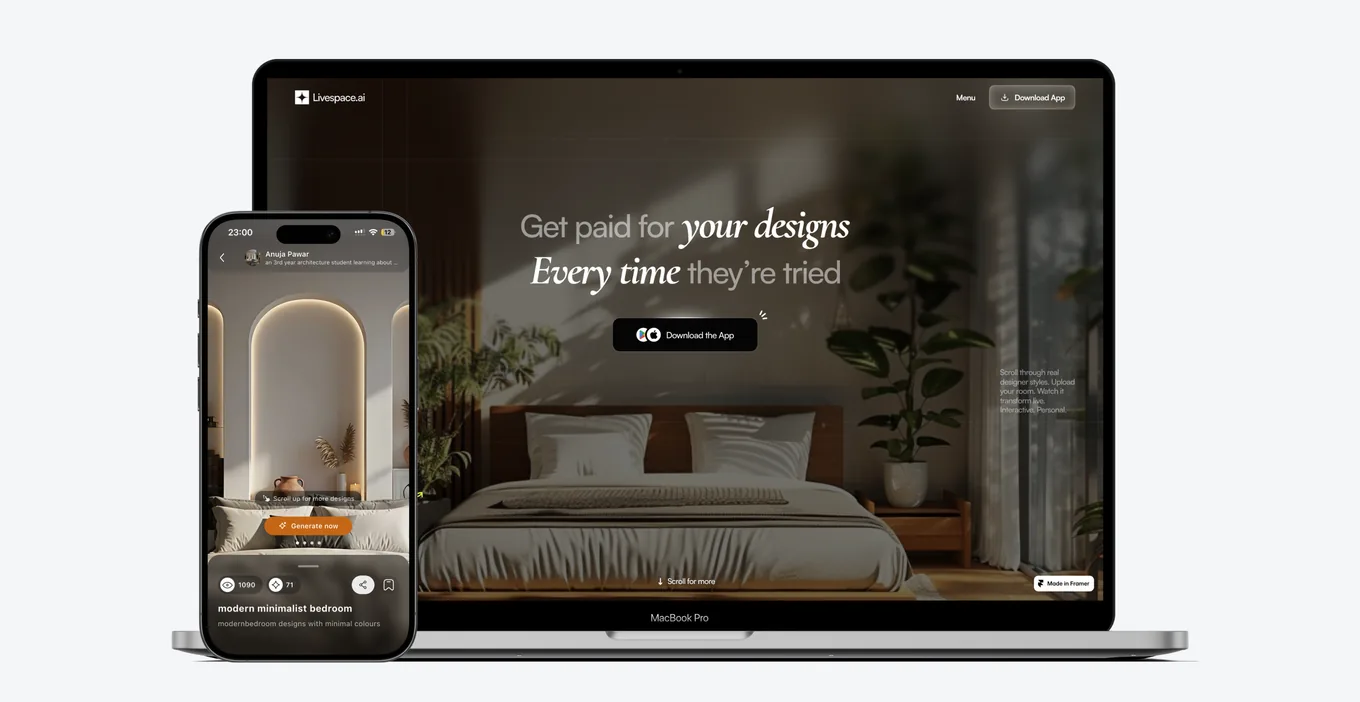
The Livespace.ai case shows designer discovery and room-generation interfaces alongside creator workflows. That is relevant experience for a product with both the person choosing a style and the designer presenting it. Inspect the screens and identify which actions your own users need.
A case study does not decide your quality threshold. Bring room examples you may use, styles you are authorised to offer and examples that should be rejected. The AI room visualiser build-or-buy guide provides a repeatable comparison exercise before you choose an implementation.
Label an illustrative test room ROOM-01. Its window is on the left wall and its entrance is on the right. Ask for a furniture and colour change while keeping those fixed features. Compare candidates against that same instruction. A shifted window is a rejection in this test even if the result is otherwise attractive.
| Review point | Question the product must answer |
|---|---|
| Room structure | Did fixed openings and the agreed layout remain usable? |
| Style trace | Which style and input version produced this result? |
| Uncertain objects | Is an item a visual suggestion or a verified catalogue match? |
| Failed attempt | Can the customer retry or recover without losing the room? |
| Saved comparison | Can the permitted user reopen the intended result? |
The room-visualiser evaluation sheet supplies twelve synthetic proposed cases with a blank observed-result column. It is a review aid, not a benchmark score or a claim that these cases passed on a client product.
A customer can close the browser while a render is running. A provider can fail, return an unwanted result or deliver the same completion twice. Agree how the app identifies the attempt, exposes its state and reconnects the user to the correct room. Separate a deliberate new variation from a retry of the same request.
The saved experience also needs storage ownership. Replicate documents temporary output-file retention for API predictions. If you use that provider, plan how a permitted result is retained in your own storage before its temporary link expires. Check the actual provider’s current behaviour during implementation; a result URL is not a long-term asset strategy.
A room photo may include people, family photographs or private possessions. Decide which images the product accepts, who can review them, which provider receives them and how removal is carried through the application. Keep shared previews separate from the original private upload.
For designer styles, record who supplied the assets and what use the product owner has authorised. For shopping, link a recommendation to a real product identifier and current destination rather than treating a generated chair as stock. Required rights, provider terms and retention decisions are reviewed with the business owner before launch.
UAE product teams should decide whether Arabic and right-to-left screens are required, who reviews mixed-language content and whether catalogue amounts are shown in AED. A product aimed at buyers elsewhere also needs the correct catalogue, delivery region and currency context. A visual match does not establish that an item can be purchased in that customer’s market.
Arcforth works remotely with founders and product teams. Agree Gulf Standard Time overlap for Dubai reviews, the product decision owner and the permitted data flow. The Dubai product studio page connects this with other UAE work; the AI product development service covers broader implementation choices.
Bring the intended customer, one room journey, permitted sample images, the style source, the required review rules and the next action after a useful render. Include the expected usage pattern and any existing app, catalogue or accounts. The proposal can then separate the interface, generation pipeline, storage, review and operating costs.
A Product Pilot is $1,499 for discovery, core flows, a clickable prototype, requirements and a roadmap. Production engineering and third-party usage are scoped separately. An existing image API can be part of the implementation; it does not replace the product, permissions and operating work around it.
An AI platform where designers productize their style and homeowners try it in their space.
View Livespace.ai Case StudyAgree one room journey and permitted evaluation set.
Compare generation approaches against the same acceptance rules.
Build upload, job handling, review and saved results.
Review the first release with representative users and an operating owner.
A Product Pilot ($1,499 once) focuses on one workflow, core flows and prototype, build-ready requirements and an MVP roadmap. A Product Squad ($3,490 per month) supports ongoing product direction, design, engineering and iteration. An Embedded Product Unit (from $5,000 per month) adds capacity for larger products and multiple workstreams.
Specify and test the fixed features your product must preserve. A convincing render alone does not establish spatial accuracy or a construction-ready plan.
Not automatically. Compare an existing app, a model API and a custom pipeline against the same room examples before choosing the engineering scope.
A shopping feature needs a separate match to real catalogue records and current destinations. An invented object in a render is not a verified purchasable product.
Yes. Livespace.ai is a UAE product example. Arcforth works remotely and agrees review overlap, content requirements and the implementation scope with your team.

If you have committed to a software venture and need a team to shape, build and keep improving it, start with a product conversation.
Human judgment. AI-native delivery. One team accountable from the first decision to every release.