01 - Define the Decision Before the Pilot Starts
MVP development in Australia should leave a founder with evidence for the next investment decision. A production pilot means a limited, agreed operating release for a reachable audience. It is different from a clickable prototype, which can test an interaction without providing production access, integrations or support.
Write the pilot’s user, task, operating boundary and next decision in four lines. For a fictional property workflow: a renter requests an available viewing, an agent accepts it, and an operator can correct a failed notification. Start with a defined property group and invitation process rather than claiming the product serves every agency.
Arcforth’s related public product example is Viewings for a New Zealand client. It provides property-workflow context; it is not an Australian client reference or evidence that the local process, provider access and release policy will be the same.
02 - Walk Through the Booking and Its Failure Cases
A good-looking booking screen can conceal two important failures: accepting two customers into the final place, or notifying a customer about a booking that did not persist. Demonstrate the same request from the customer, agent and operator perspectives.
| Scenario | Expected behaviour to agree | Evidence |
|---|---|---|
| Last place requested twice | Only the allowed capacity is confirmed | Two test requests; final accepted records |
| Notification provider unavailable | Booking state remains clear; operator can recover | Recorded status and controlled retry |
| Agent cancels a session | Affected customers see the agreed next step | Customer and operator views |
| User retries a request | No unintended duplicate confirmed booking | One traceable accepted request |
These are proposed acceptance cases, not claims about a delivered client implementation. Use safe test identities during rehearsal. Agree what happens when a provider is unavailable instead of assuming that every failure can be hidden with another retry.
03 - Write Times for the Market You Actually Serve
Record the viewing’s local time zone with its location. Specify the review schedule for the delivery team separately. A date shown in Sydney and a meeting reviewed from Perth should not rely on an unlabeled time string or a general promise to work in Australian hours.
Have the business owner supply representative dates around any local clock change relevant to the launch market. Check the invitation, confirmation, cancellation and calendar export together. Agree what a user sees when their device is in a different time zone. Avoid treating a fixed offset as the whole product policy.
At kickoff, set actual AEST/AEDT or other required review windows, decision deadlines and release contacts. Those working arrangements are agreed for the engagement; they do not imply an Australian office or round-the-clock availability.
04 - Measure a Completed Task and the Support Cost
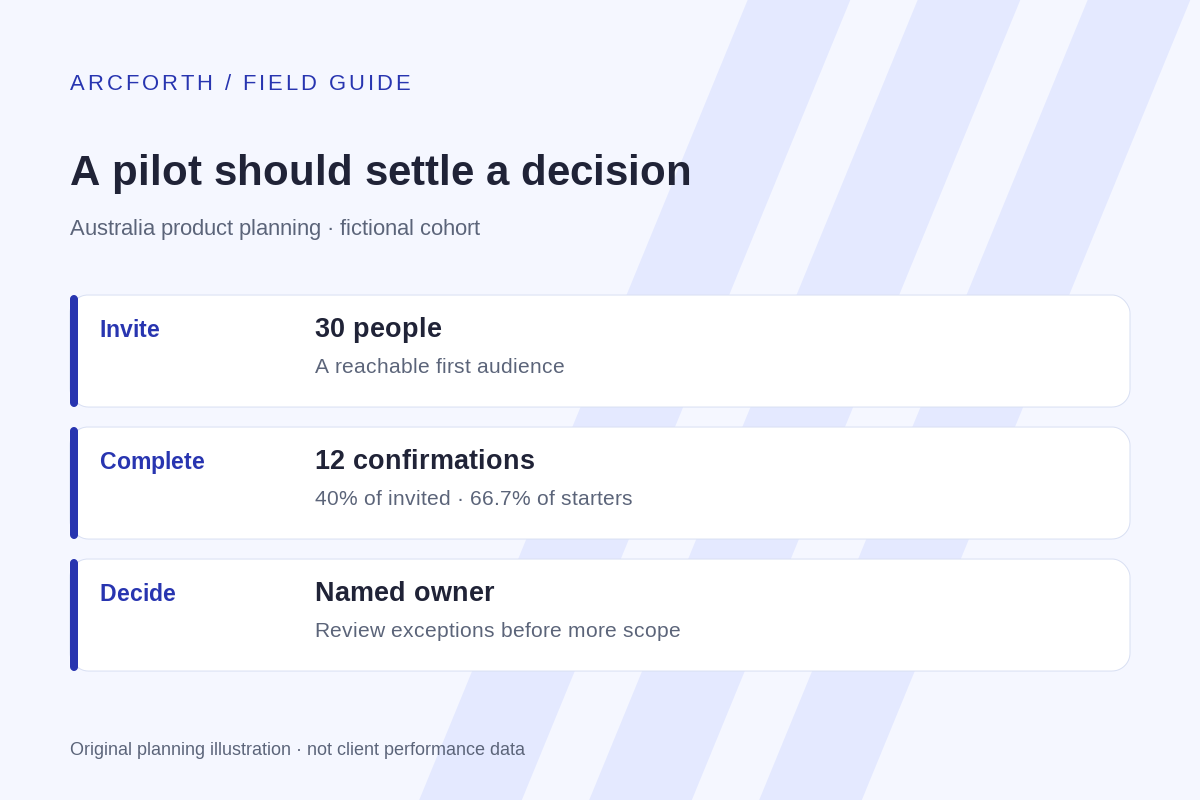
Use the same cohort for a pilot rate. In a fictional review, 30 invited people include 18 who start a booking and 12 who receive a valid confirmation. The invitation-to-confirmation rate is 12/30 = 40%; the start-to-confirmation rate is 12/18 = 66.7%. Neither rate proves payment or commercial demand.
Add the number of support interventions, cancelled requests and unresolved exceptions. A release that completes 12 bookings only after 12 manual corrections creates a different operating decision from a release that completes them independently. Record why a user could not finish when actual evidence is available; do not infer every reason from an exit page.
The Australian MVP pilot decision sheet separates the audience, success event, denominator, exception and decision owner. Fill it with your own observations. The numbers here are arithmetic examples, not Arcforth performance benchmarks.
05 - Make the Release and Recovery Reviewable
Name the accounts, integrations and permissions required for this first operating release. Rehearse the critical path in a test environment, document the deployment reference and give the release approver an explicit go/no-go decision. Keep a known recovery procedure and an owner who can perform it.
If the pilot accepts payments, test the chosen provider’s success and failure scenarios in its designated testing environment. Stripe documents simulated payment testing; a simulated payment does not move real funds or demonstrate that a customer paid. Provider availability and account onboarding remain dependencies to confirm for the actual business.
Keep engineering and operating costs separate from the decision to launch. A monthly team rate does not tell you how many months this release needs. Agree the scope, people, capacity, dependencies and included support in a written proposal.
06 - Choose What Happens After the Pilot
Before inviting users, define the possible decisions: continue the same workflow, repair a specific failure, change the audience or stop. Give each decision a reviewer and the evidence they will use. A target is a working decision rule, not a statistical guarantee or a promised conversion rate.
Our MVP development service for Australian teams connects product definition, design, engineering and QA. Use the proposal checklist to compare the same pilot boundary with each candidate. Bring the first user task and a reachable pilot audience to plan your Australian MVP pilot.
Frequently Asked Questions
Is a clickable prototype a production pilot?
No. A prototype can test the interaction. An operating pilot needs agreed integrations, permissions, release acceptance, support and recovery for its limited audience.
Does the 40% example set a conversion benchmark?
No. It demonstrates two denominators using fictional records: 12 confirmed users from 30 invited, or 12 from 18 starters. Your business must choose its own decision rule.
Is Viewings an Australian case study?
No. It is published work for a New Zealand client. Australian workflows and requirements are assessed separately.
Choose what the first pilot must prove.
Bring one reachable audience and complete customer task. Agree the acceptance evidence, exceptions and next investment decision.
The design, engineering, and product research collective at Arcforth building tomorrow's category-defining digital products.