Define the permitted conversation
Set the information the agent may use, the fields it needs to collect and the point where it must stop or escalate. Keep business policy in a reviewable source.

Services
Start with one call your business needs to handle: qualifying an enquiry, collecting a request or routing an existing customer to the right person. Arcforth connects the conversation to approved information, system actions and human handoff.
Set the information the agent may use, the fields it needs to collect and the point where it must stop or escalate. Keep business policy in a reviewable source.
Decide whether the call creates a request, updates a record or proposes a booking. Validate the action and distinguish a proposal from a confirmed result.
Agree who receives an escalation, which context they need and what happens when that person is unavailable. A transfer button alone is not a support process.
A phone provider’s call status does not establish that a lead was qualified or a request was resolved. Twilio documents that a completed call can include a person, an IVR or voicemail. Your product needs its own business outcomes and acceptance evidence.
Choose the unit you want to measure: a successfully captured request, an accepted transfer or an authorised system update. Keep connection status, conversation result and downstream delivery separate. This gives the operator a useful view of the queue and prevents a call-volume dashboard from being mistaken for acquisition or service success.
Imagine a caller asking about a service. The agent can collect the requested work, timing and contact preference from the caller, answer from an approved service description and offer a human handoff. It should not invent a price or promise availability that the business has not supplied.
These are illustrative acceptance cases. Your call purpose, languages, operating hours and provider capabilities determine the actual scope.
Test realistic interruptions, corrections, missing information, background noise and unsuccessful handoffs. Review whether the collected information is accurate and whether the next action really happened. Include telephony, transcription, model usage, review and integration costs in the operating model.
Agree the call and recording requirements with the people responsible for your market and service before launch. Do not assume one setup suits every country or purpose. Our AI pilot ROI guide explains the difference between model charges and the cost of a completed workflow. The agent workflow guide covers approvals and action boundaries.
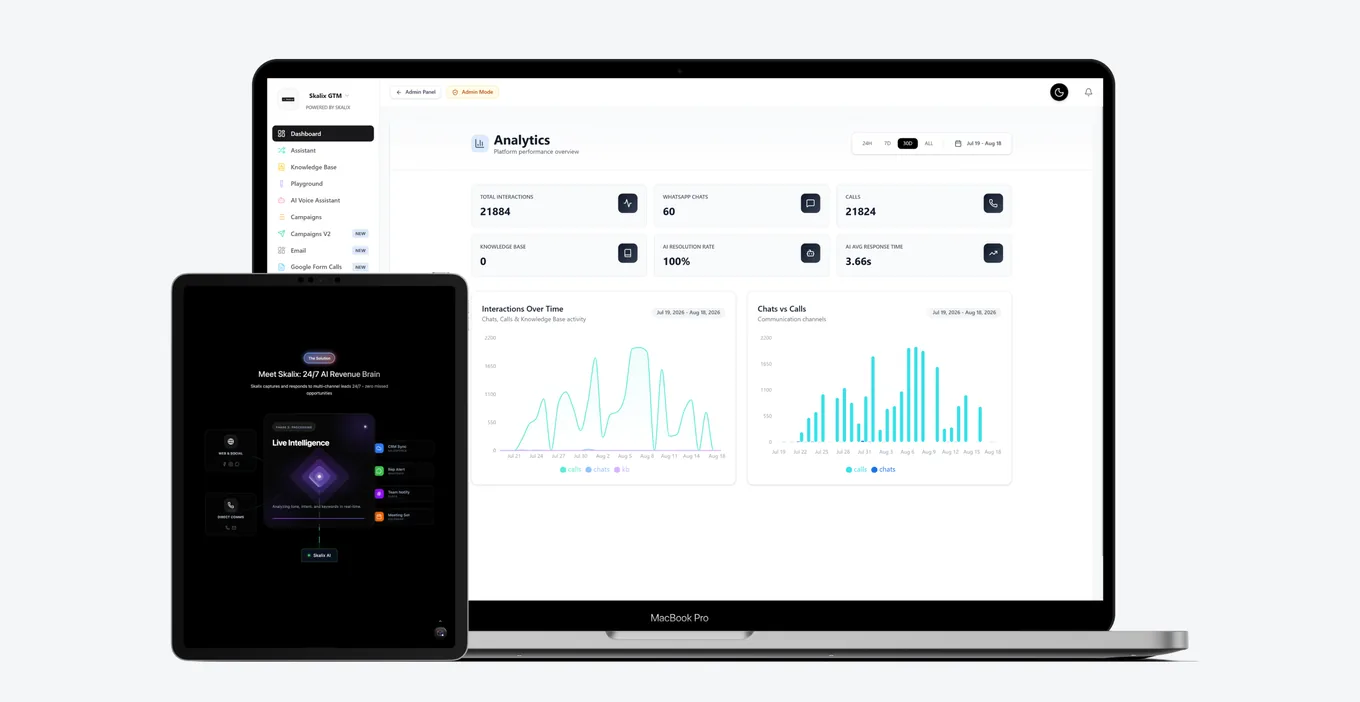
Skalix AI is relevant product work spanning voice agents, web chat, follow-up, CRM workflows and human handoff. Review the public case to discuss the product journey, rather than assuming its scope, provider choices or results apply unchanged to your business.
Bring one call purpose, approved information, the destination system, the current human process and the owner of escalation. Include anticipated call patterns, working hours and the decisions a pilot must resolve. If voice is one channel in a wider product, compare our AI product development service. If the task is an existing SaaS feature, use AI feature integration to define how it fits the current application.
An AI-native revenue platform for calls, chat and customer follow-up.
View Skalix AI Case StudyMap one call purpose, approved information and the human escalation process.
Evaluate representative calls and verify the proposed system actions.
Build the conversation, integrations, review and outcome tracking within an agreed scope.
Pilot with defined operating ownership and review quality, handoff and cost evidence.
A Product Pilot ($1,499 once) focuses on one workflow, core flows and prototype, build-ready requirements and an MVP roadmap. A Product Squad ($3,490 per month) supports ongoing product direction, design, engineering and iteration. An Embedded Product Unit (from $5,000 per month) adds capacity for larger products and multiple workstreams.
Those actions can be evaluated as part of the workflow. The proposal needs to confirm provider access, validation, approval boundaries and how a confirmed result is distinguished from a proposed or failed action.
No. Call connection status and business qualification are different measures. Agree the qualification criteria and verify the downstream record before counting the result.
Do not assume so. Call purpose, provider availability, languages and market-specific requirements need review with the people responsible for the service before launch.

If you have committed to a software venture and need a team to shape, build and keep improving it, start with a product conversation.
Human judgment. AI-native delivery. One team accountable from the first decision to every release.