01 - Price the Buying Journey Before the Platform
A Dubai founder asking about procurement software cost may be describing three different products: a tool for the company’s own buying, a supplier portal connected to its ERP, or a procurement platform sold to other companies. Those choices change the roles, data boundaries and operating responsibilities before anyone chooses a framework.
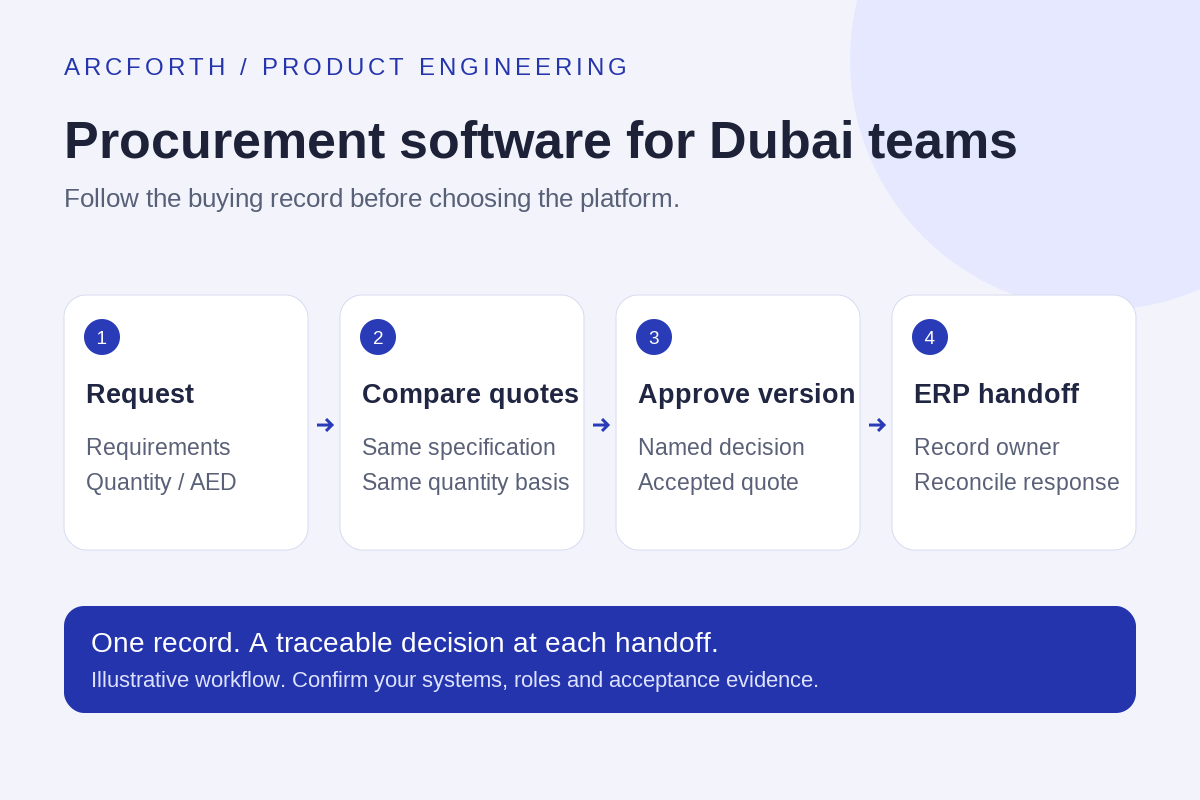
Write one sentence for the first release. For example: an invited supplier responds to one RFQ, the buyer compares equivalent offers, and an approver accepts a named version. Keep delivery tracking, invoices and payment outside that sentence unless the release needs them. This is an illustrative scope, not a quote or a completed client project.
Our CollectiveSpend METIS case is related procurement product work for a UAE client. Its screens help make the buying workflow concrete. A case screenshot cannot determine the budget for your users, data and ERP.
02 - Separate Four Costs That Often Get Quoted Together
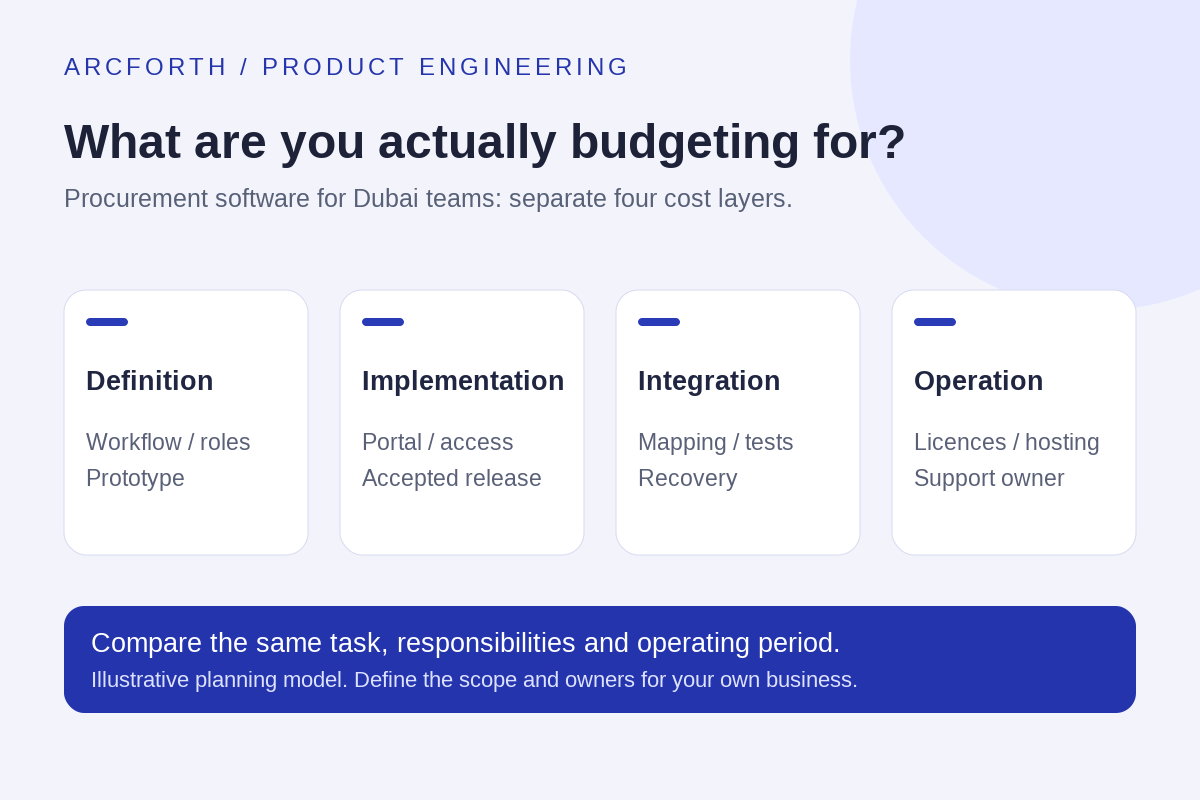
Compare proposals using the same cost categories. A low implementation number can leave external-user licences, migration or support outside the quote. A large feature list can include work your first supplier will never use.
| Cost layer | What the estimate should explain | Question for the owner |
|---|---|---|
| Product definition | Roles, workflow, prototype and acceptance checks | What decision becomes clearer at the end? |
| Implementation | Configured modules, custom interface and permissions | Which complete task can users finish? |
| Integration and migration | Mapping, supported interfaces, test data and recovery | What is transferred, and who reconciles it? |
| Operation | Hosting, licences, monitoring, support and provider changes | Who runs the release after handover? |
For procurement software cost planning, distinguish the initial build from the recurring operating budget. List unknown dependencies explicitly. If the ERP supplier, interface access or external-user arrangement is not decided, its cost is unresolved rather than zero.
03 - What Arcforth’s Published Offers Actually Cover
Arcforth publishes a Product Pilot at $1,499 once for discovery, core flows, a clickable prototype, build-ready requirements and a roadmap. Production engineering is agreed separately. A Product Squad is $3,490 per month; an Embedded Product Unit starts from $5,000 per month. These prices are in USD and describe engagement starting points, not a fixed price for a complete procurement suite.
An illustrative staffing budget for two months of the published Product Squad is 2 × $3,490 = $6,980. Adding the optional $1,499 Product Pilot gives $8,479. That arithmetic does not establish that your platform fits two months or that the proposed team and capacity are available. The written scope must settle those questions.
Hosting, ERP or portal licences, third-party providers, translation, taxes and additional work are not priced by this example. Compare complete proposals in a stated billing currency and confirm which charges are included. We have not converted a USD example into a supposedly current AED quotation.
04 - Use the Same Request to Reveal Scope Differences
Our synthetic procurement demo pack asks each option to handle the same request and supplier offers. It includes a pack-size difference, a lower-priced item that misses the specification and a changed quote. All records and policies are fictional test inputs.
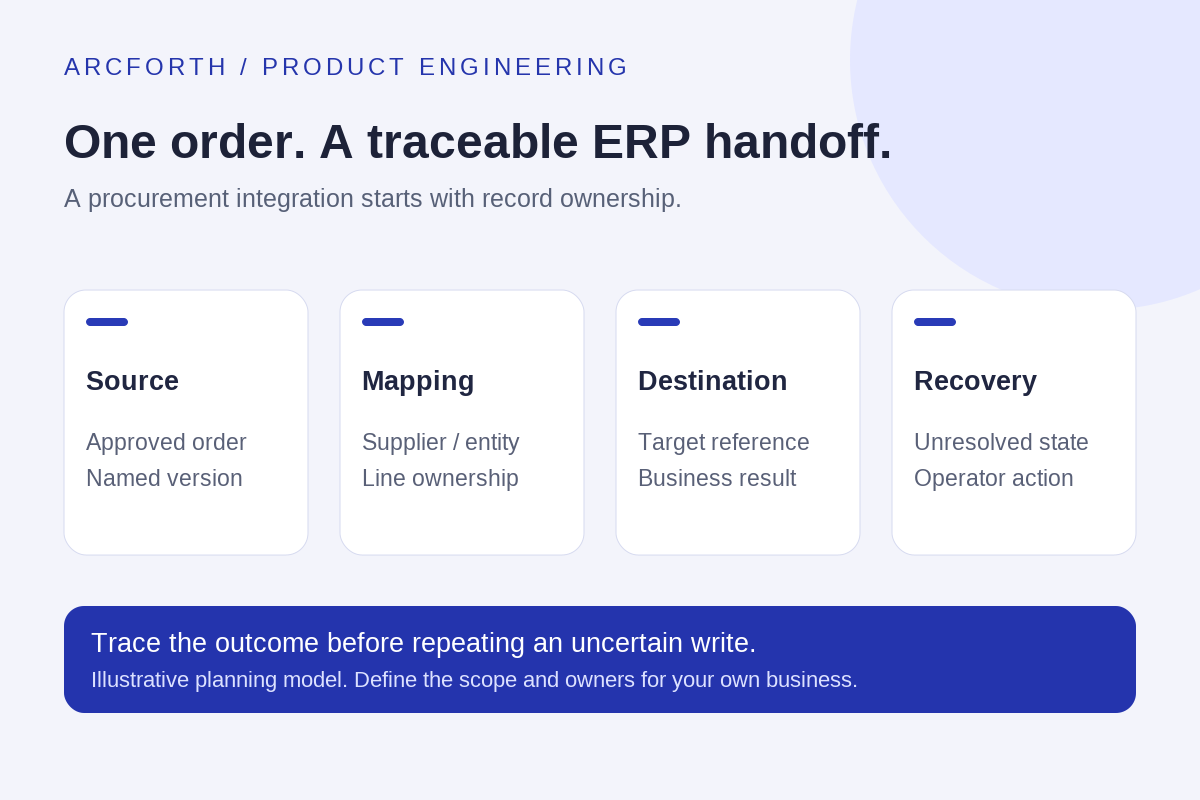
Map the demonstration to work someone has to price. Quantity normalisation needs an agreed unit model. A changed quote needs version handling and a review decision. Showing the current eligible offers needs buyer permissions and a comparison interface. An ERP write adds mapping, access, delivery tracking and recovery to that earlier scope.
Ask the supplier to mark each capability as available in your edition, configurable, a proposed extension or unavailable. Record the observed result in the procurement decision brief. This is more useful than comparing two quotes that both say RFQ management but include different responsibilities.
05 - When Configuration, an Extension or a Custom Product Fits
Start by demonstrating the journey in the system you already pay for. Oracle documents supplier registration and review, and Microsoft documents vendor collaboration. Their documented capabilities are a reason to investigate configuration, not proof that your current licence or process is covered.
A custom supplier portal can make sense when the external user journey, buying-entity rules or product offering needs behaviour the selected module cannot provide. Explain that gap in operational terms: which person cannot complete which task, and what must happen instead. The supplier-portal development service for Dubai teams starts from that boundary.
Use the Build or Buy tool only after establishing workflow fit. Enter your own implementation, subscription, support and evaluation-period assumptions. The tool compares those inputs; it does not supply a market quote or predict savings.
06 - Resolve UAE Requirements Before the Estimate Becomes a Contract
Name the required currencies, language journeys, supplier organisations and buying entities. Decide who checks Arabic content and right-to-left layouts if required, and which system owns supplier identity and commercial amounts. Assign the review of hosting, access and retention to the organisation’s responsible owners.
An ERP connection and an eInvoicing-provider handoff are separate scopes. Read the procurement ERP-integration guide for the order boundary and the UAE eInvoicing guide for invoice-data responsibilities. Confirm actual provider documentation and current requirements before pricing either one.
Remote delivery also has a cost boundary. Agree Gulf Standard Time review overlap, who can answer workflow questions, the release approver and any on-site requirement. A monthly team engagement does not automatically include travel or a local office.
07 - Compare a Proposal Against the First Accepted Release
The reviewable proposal names the first task, roles, integrations, exclusions, people and capacity. It states what the customer must provide and what happens when an unresolved dependency changes the plan. Include source ownership, deployment access, handover and operating support in the same comparison.
For a supplier-facing build, use the supplier-portal acceptance matrix to make permissions and changed-record cases visible during scoping. For team responsibilities, the outsourcing-model guide distinguishes what the buyer and delivery team each retain.
Bring a safe sample request, current systems, required release and budget range to discuss your Dubai procurement build. That gives the estimating conversation a concrete workflow and a clear next decision.
Frequently Asked Questions
Is $1,499 the cost of the full procurement platform?
No. The Product Pilot covers discovery, core flows, prototyping, requirements and a roadmap. Production engineering, integrations and third-party costs are scoped separately.
Does the $8,479 example quote a two-month delivery?
It is illustrative budget arithmetic: two months at the published $3,490 Product Squad rate plus the optional $1,499 pilot. It is not a delivery-duration commitment or a project quotation.
Should we request an AED estimate?
Confirm the billing currency and included charges in each proposal. Arcforth’s published engagement prices are in USD. Compare complete scope and operating cost without treating an unstated conversion as a current quote.
What information makes an estimate more useful?
One first-release workflow, supplier and buyer roles, representative safe records, the current ERP, available interface documentation, decision owners, budget range and known dependencies.
Price the workflow your Dubai team can accept.
Bring the first task, supplier and buyer roles, current systems and budget range. Separate the pilot, engineering and operating costs in the proposal.
The design, engineering, and product research collective at Arcforth building tomorrow's category-defining digital products.