Register and review a supplier
Collect the details your business requires, return incomplete submissions for correction and preserve the internal approval that authorises the relationship.

Services
Give suppliers one place to register, answer an RFQ and follow the order they are responsible for. Arcforth builds supplier portals around your buyer, approver and finance workflows, with explicit access rules and a defined connection to your existing systems.
Collect the details your business requires, return incomplete submissions for correction and preserve the internal approval that authorises the relationship.
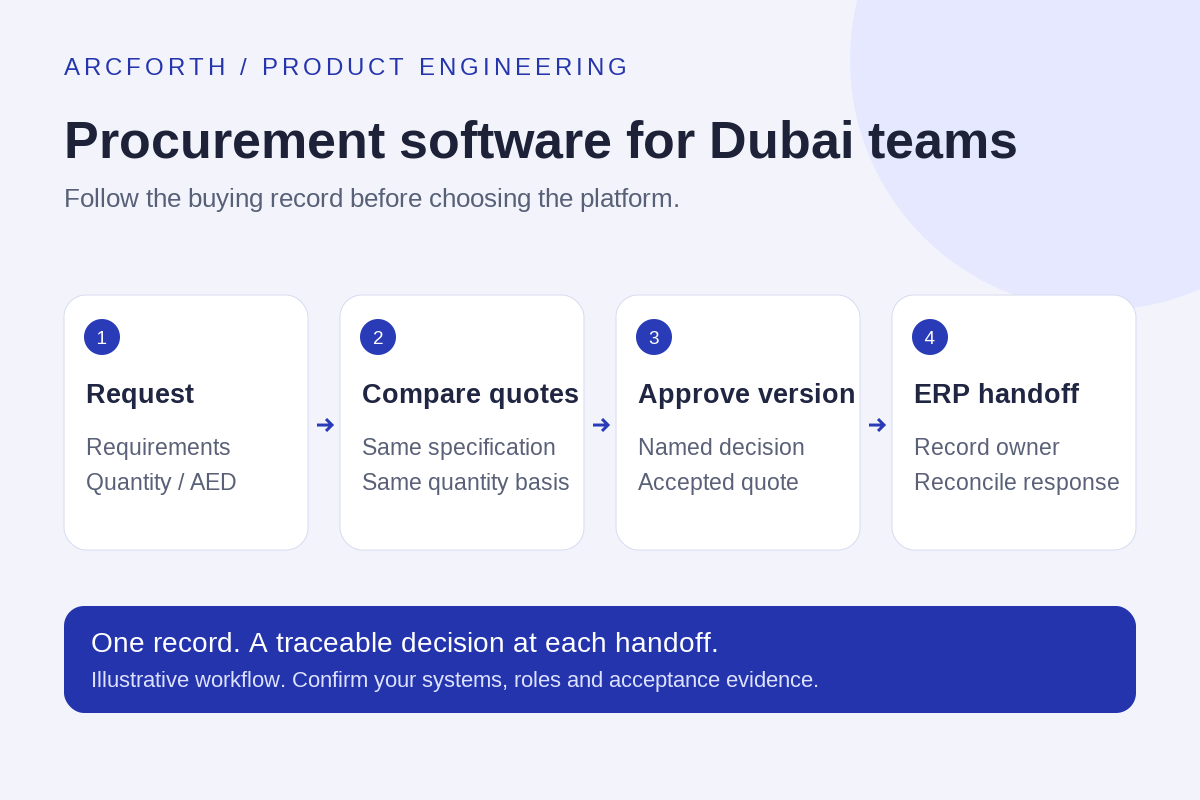
Give invited suppliers the same specification, quantity basis and deadline. Preserve revisions so the buyer and approver review the same version.
Show the supplier its permitted orders and required next action. Distinguish a supplier response, internal confirmation, delivery and payment evidence.
A portal becomes useful when a supplier repeatedly needs something from your team: an invitation, a corrected document, an answer about an order or confirmation that a quote was received. Choose the task generating those messages before collecting a catalogue of possible features. A registration form by itself does not settle who can approve the supplier, which buying entity it belongs to or when its details become authoritative.
For an illustrative Dubai operator buying for several sites, one contact may serve a warehouse and an office while the budgets belong to different teams. Model the supplier organisation, its contacts, the buying entity and the site separately. Then decide whether access follows an invitation, an approved supplier relationship or an explicit assignment. This is a proposed workflow to adapt, not a description of a client incident.
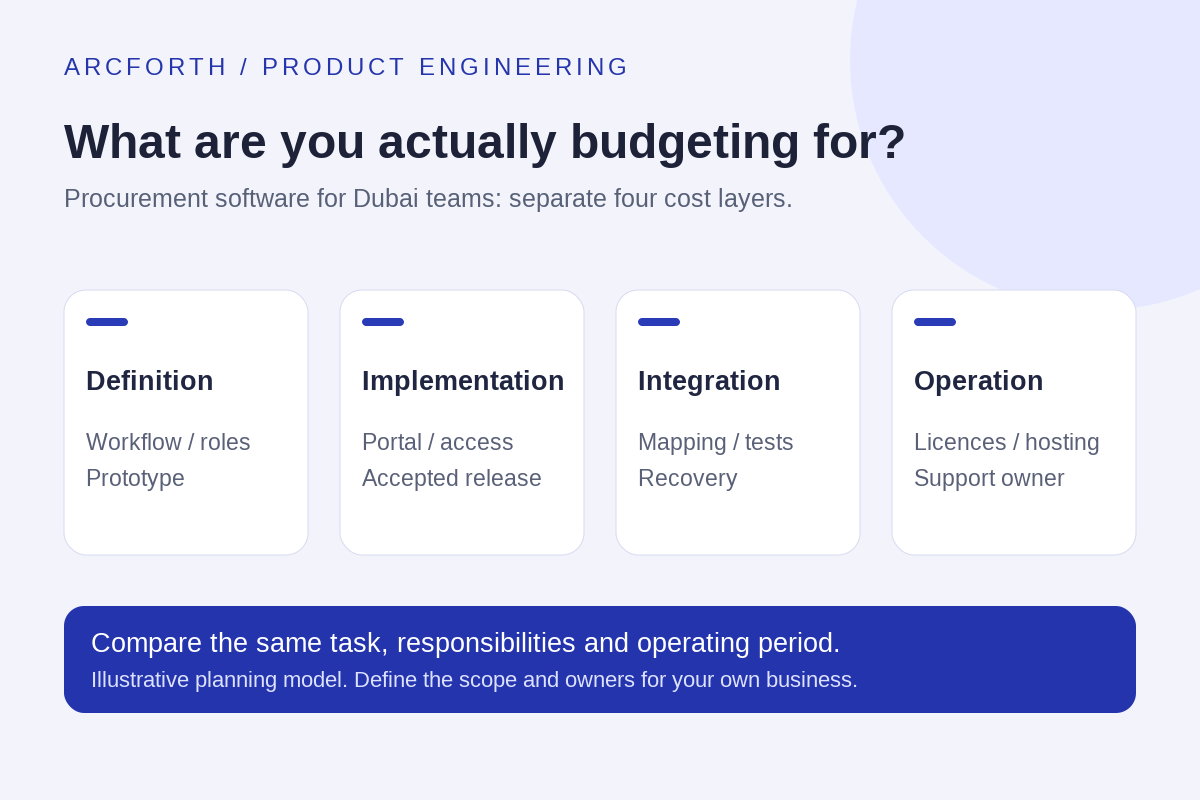
Supplier portal development can start with one journey. Keep invoice submission, settlement, supplier scoring and a mobile application outside the first release unless the chosen task depends on them. The Dubai procurement cost guide explains how those decisions change the budget.
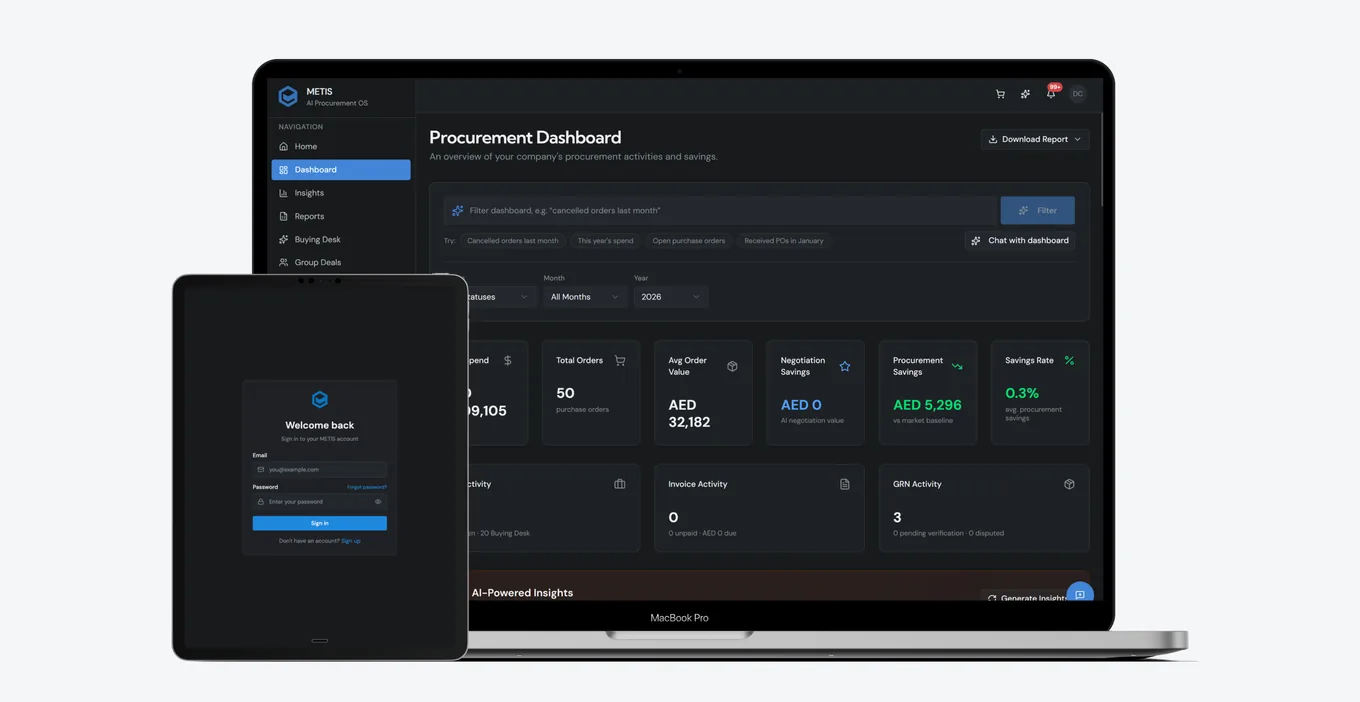
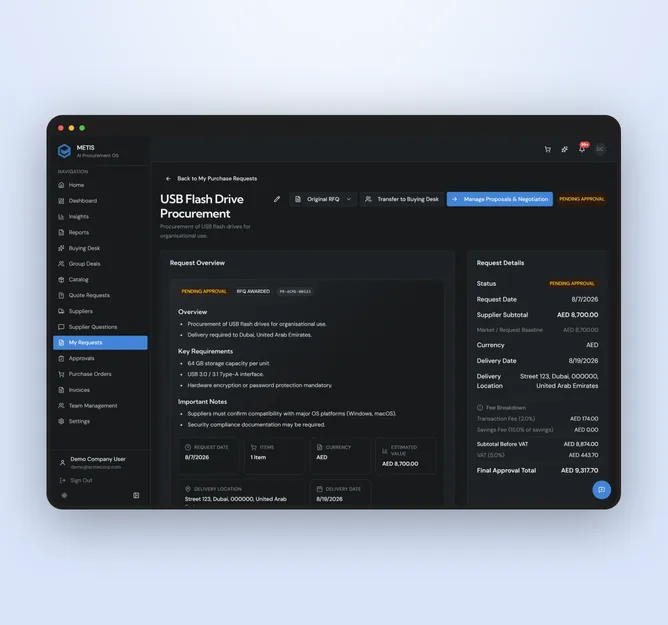
The public CollectiveSpend METIS case shows procurement product work for a UAE client. One request for USB flash drives keeps specifications, quantity, AED totals and the approval state together. The Dubai build walkthrough follows that record through the buyer decisions.
For your supplier side, decide which fields are visible, which answers are required and which changes invalidate the previous review. A supplier should not have to guess whether its response was received. A buyer should be able to compare equivalent quantities and a named approver should see the version being accepted. The portal screen, buyer comparison and approval history are one business journey.
A demonstration with one administrator cannot show whether supplier separation works. Use two synthetic supplier organisations, contacts with different roles and a buyer assigned to one site. Test the visible list, direct record links, documents, exports and update actions. Hiding a row in the interface is only one part of the acceptance check.
| Proposed test | Expected business result |
|---|---|
| Supplier A opens Supplier B’s quote | The record and its attachments are unavailable to A |
| A second contact joins Supplier A | Access follows the explicitly granted role and organisation |
| A contact is removed | The revoked account cannot continue reading or changing records |
| A buyer reviews another site’s request | The agreed site or entity boundary still applies |
The supplier-portal acceptance matrix contains twelve synthetic cases and a blank observed-result column. Adapt the permissions to your policy, then ask the delivery team to demonstrate the allowed and denied actions.
A custom interface is one option. Your current system may already support part of the journey. Oracle’s supplier-registration documentation describes registration and internal review. Microsoft’s vendor-collaboration documentation covers supplier work with purchase orders and RFQs. Check your actual product, licence, configuration and roles before commissioning a replacement.
Compare configuration, an extension and a custom portal against the same supplier task. If an existing module fits the process, implementation and data cleanup may be the useful scope. If the supplier experience or multi-entity workflow is your product advantage, a separate interface can be worth evaluating. Use the procurement fit review before comparing your own cost assumptions.
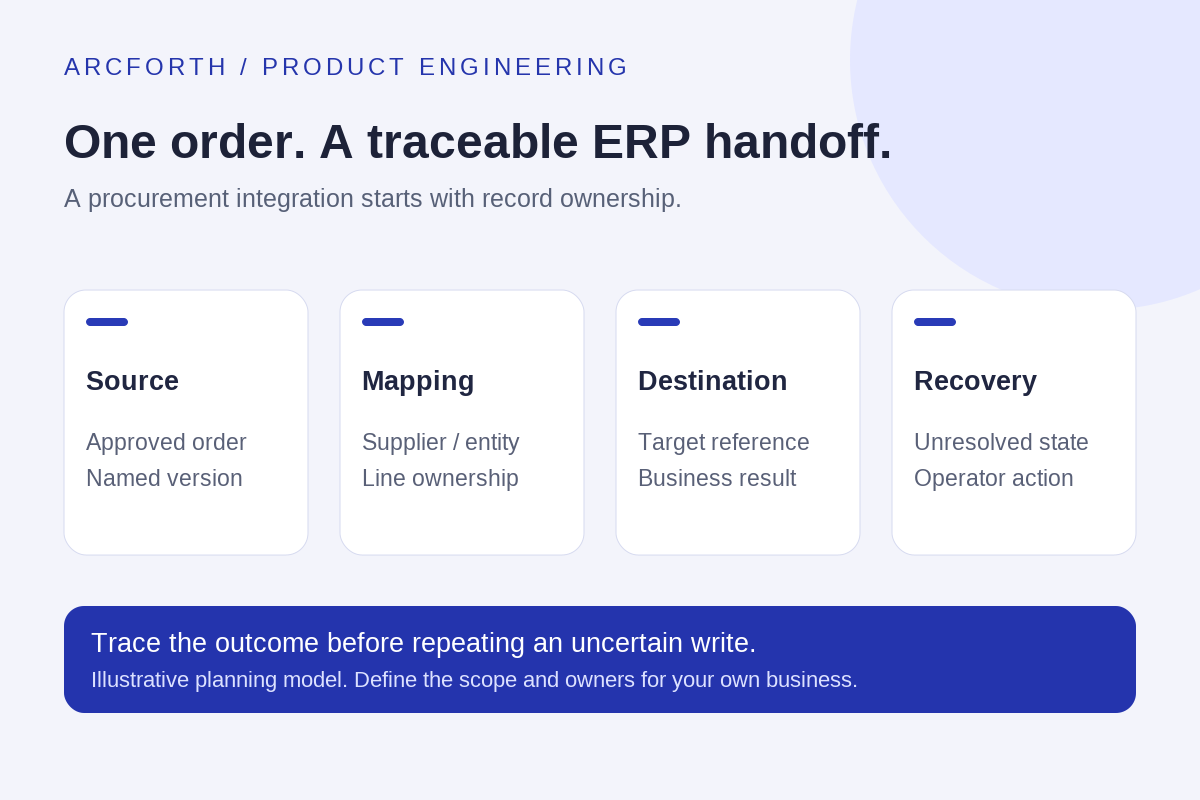
Choose which system owns the supplier, site, approved quote and order identifier. An account approved in the portal is not automatically a valid supplier in the ERP. A supplier accepting an order is not automatically proof of finance confirmation or payment. Record the transition and the person authorised to resolve a mismatch.
Our UAE procurement ERP-integration guide works through one order and the cases that make its handoff reliable: changed versions, repeated delivery, a rejected mapping and an ambiguous timeout. Production credentials, a supported API and a test environment are dependencies to confirm before a connector is priced.
Agree whether suppliers quote only in AED, whether foreign-currency quotes are allowed and who supplies conversion rates. Show the quantity basis and currency beside the amount so a comparison does not quietly mix packs, units or currencies. If Arabic or right-to-left screens are required, identify the content owner and representative users who will check the forms, filenames and mixed-language records.
Arcforth works remotely with Dubai and UAE teams. Confirm Gulf Standard Time review overlap, decision owners, hosting and document-access requirements during scoping. This service page does not represent a Dubai office or a government registration service. For official Dubai tendering, use the relevant eSupply portal rather than a custom enterprise portal.
Bring one registration or RFQ journey, its supplier roles, the internal approver and the current ERP. Include a safe sample record, required documents, operating volume and the next business decision date. Use the acceptance matrix to mark which capabilities exist, which need configuration and which need engineering.
A $1,499 Product Pilot covers discovery, core flows, a clickable prototype, requirements and a roadmap. Engineering is scoped separately. The published Product Squad is $3,490 per month and an Embedded Product Unit starts from $5,000 per month; the proposal confirms people, capacity, integration scope and third-party costs. A useful estimate connects that offer to the release you can accept, rather than treating a monthly team price as the price of an entire platform.
| Compared | Use the existing module | Extend or build a portal |
|---|---|---|
| Good starting point | The supported workflow fits your supplier task | A defined gap changes how your users complete the task |
| Work to estimate | Configuration, data cleanup, access and rollout | Interface, permissions, integration and operation |
| Evidence to request | The task demonstrated in your current edition | The same task with the proposed custom boundary |
| Costs to include | Licences, external users and implementation | Engineering, hosting, provider costs and support |
A tailored procurement platform spanning sourcing, RFQs and purchase orders.
View CollectiveSpend Case StudyChoose one supplier task and its internal decision owner.
Prototype the roles and agree allowed and denied acceptance cases.
Implement the portal and the supported integration boundary.
Release to an agreed supplier cohort with support, recovery and handover owners.
A Product Pilot ($1,499 once) focuses on one workflow, core flows and prototype, build-ready requirements and an MVP roadmap. A Product Squad ($3,490 per month) supports ongoing product direction, design, engineering and iteration. An Embedded Product Unit (from $5,000 per month) adds capacity for larger products and multiple workstreams.
Arcforth offers remote supplier-portal development for Dubai and UAE teams. Our CollectiveSpend case provides related UAE procurement product work. The proposal confirms your workflow, team, integration boundary and working-hour overlap.
Compare the task against the module you already own. Configuration can fit standard journeys. A custom interface or extension should address a documented gap and preserve explicit record ownership.
The expected access boundary must be defined and tested. Use two synthetic organisations to check lists, direct records, attachments, exports and updates. The downloadable matrix gives proposed allowed and denied cases.
The price depends on the chosen workflow, roles, documents, integration and rollout. A $1,499 Product Pilot covers discovery and prototyping; production engineering is separate. Published team offers are starting points whose people, capacity and scope are confirmed in the proposal.
No. This is custom product and integration engineering for an agreed business workflow. Official procurement registration and the selected invoice-provider responsibilities remain separate.

If you have committed to a software venture and need a team to shape, build and keep improving it, start with a product conversation.
Human judgment. AI-native delivery. One team accountable from the first decision to every release.