01 - What Is a Forward Deployed Engineer? The Short Answer
A forward deployed engineer (FDE) is a software engineer who works inside a customer's business, next to the people who run the work, and ships production software there. A product engineer builds one product for many customers from inside the product company. An FDE takes a product, or builds a new one, into one customer's real data, systems and operations, and makes it work there.
Palantir made the role well known by embedding engineers with customers to build and run software in the field. One of its job listings, quoted by Fortune, says an FDE's "responsibilities look similar to those of a startup CTO." AI companies have since copied the model. Joe Schmidt of Andreessen Horowitz explained why in a 2025 article on the role: enterprise AI products "require deep integrations and context," and "that's where forward deployed teams come in: to operationalize the model into a real-world solution."
So when someone asks what is a forward deployed engineer, the shortest useful answer has three parts:
- Where they work: inside the customer's team, tools and data, not at arm's length.
- What they produce: working production software, not slides, specifications or a demo.
- What they own: an outcome agreed with the customer, such as a workflow running in production and used by real people.
02 - What Does a Forward Deployed Engineer Do Day to Day?
The work changes week by week, but it usually covers five things:
- Learning the workflow first-hand. Sitting with operators, watching how the work really gets done and writing down the rules nobody wrote down. Real processes rarely match the policy document.
- Writing production code against real data. Integrations, data pipelines, workflow logic and interfaces, tested and released into the customer's environment.
- Connecting the systems already there. The ERP, the CRM, identity and single sign-on, the data warehouse and the legacy database nobody wants to touch.
- Turning a pilot into something people use. Adding the permissions, monitoring, error handling and human review steps that a demo skips.
- Feeding lessons back. What breaks, what users keep asking for, and what should become part of the core product instead of a one-off.
Early in an engagement the work is mostly discovery and quick prototypes. Later it is mostly shipping, hardening and handing over. What stays the same is how the engineer is judged: by software in use, not by hours logged or tickets closed.
03 - Why Forward Deployed Engineers Are in Demand in 2026
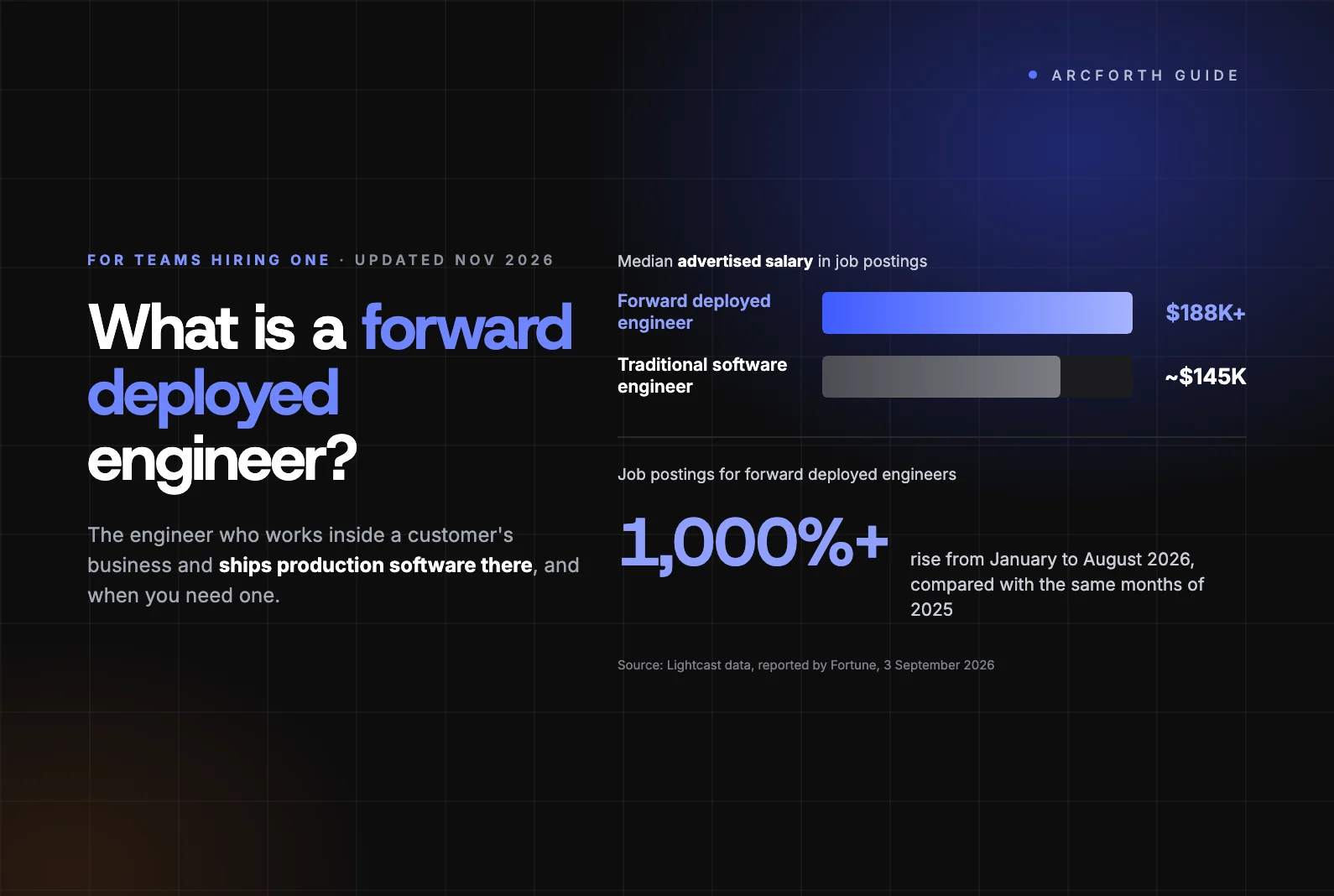
Few engineering roles have grown this fast. Lightcast data reported by Fortune in September 2026 shows job postings for forward deployed engineers rose more than 1,000% from January to August 2026 compared with the same months of 2025, and more than 4,600% compared with 2023. The median advertised salary was more than $188,000, against roughly $145,000 for traditional software engineers.
The reason is the gap between an AI demo and AI in production. A model can answer questions in a demo within a day. Making it work inside a company means connecting it to messy data, real permissions, existing systems and people who have never used it. S&P Global Market Intelligence found that 42% of companies abandoned most of their AI initiatives before production, one of the figures in our startup statistics. That last mile cannot be built from a requirements document. Someone has to be there.
Schmidt's article also explains why software companies accept the cost. Hands-on deployment work lowers gross margin, but it gives the vendor control over how data and workflows enter its product, and that control is hard for a competitor to copy. He calls it trading margin for moat.
04 - Forward Deployed Engineer vs Software Engineer, Solutions Engineer and Consultant
The titles overlap, so it helps to compare them on where the person works, what they deliver and what they are measured on.
| Role | Where they work | What they deliver | Measured on |
|---|---|---|---|
| Forward deployed engineer | Inside the customer's team and systems | Production software in the customer's environment | A workflow running in production for that customer |
| Product software engineer | Inside the product company | Features shipped to every customer | Product quality and delivery speed |
| Solutions or sales engineer | With prospects, around the sale | Demos, technical answers and proof-of-concept setups | Deals won and smooth onboarding |
| Consultant | Outside the team, advising | Recommendations, plans and specifications | The quality of the advice |
| Staff augmentation contractor | In your team, on your tasks | The tickets you assign | Hours and tasks completed |
The sharpest difference is ownership. A contractor does the tasks you assign, and a consultant tells you which tasks to do. A forward deployed engineer is expected to find the right tasks by working alongside your people, then do them in production and stand behind the result. That is why the role needs senior engineers who are also comfortable in a room full of non-technical operators.
05 - When Does a Company Need a Forward Deployed Engineer?
Teams that search "what is a forward deployed engineer" are usually asking a second question: do we need one? Bring in forward deployed engineering when the hard part of a project is the last mile into real operations. Common signs:
- An AI or software pilot works in a demo but stalls before people use it every day.
- The workflow is messy: exceptions, approvals, paper forms and systems that were never meant to talk to each other.
- The real requirements can only be found on site, by watching people work.
- Enterprise customers keep asking for integrations or customisation your product team cannot absorb.
- You need senior engineering capacity in weeks, not after a three to six month hiring search.
You probably do not need one when the product is standard, the specification is clear and there is little to integrate. A normal product team, or an off-the-shelf tool, will be cheaper. If you are still deciding what to build at all, start with scope: our guide to building an AI MVP covers that step.
06 - Hire, Contract or Embed: Three Ways to Get FDE Capacity
Hiring a forward deployed engineer, buying an embedded delivery engagement and commissioning a project are different decisions. First decide whether you need a permanent employee, implementation capacity around a workflow you already own, or a team to shape and deliver the product.
| Option | What to agree | How to compare cost | Start depends on |
|---|---|---|---|
| Hire in-house | Your role, technical leadership and customer deployment responsibilities | Compensation, recruitment, employer costs, management and operating support | Your actual recruiting and onboarding process |
| Embedded engineering engagement | Named workflow, engineering owner, access, acceptance checks and handover | Quoted delivery capacity and included responsibilities over the same period | Confirmed availability, scope and access to the required systems |
| Product delivery team | Product direction, design, engineering, QA and release boundaries | The whole team scope, your decision time, excluded work and ongoing costs | The agreed discovery, dependencies and release plan |
Arcforth publishes a Product Squad at $3,490 per month and an Embedded Product Unit from $5,000 per month. Those are engagement offers, not a salary benchmark or a guaranteed price for one FDE. A proposal must confirm people, availability, responsibilities and scope. A published salary figure elsewhere in this article is labour-market context, not a directly comparable complete delivery quote.
Use the FDE deployment brief to give candidates the same starting task. It asks for the workflow, environment, authorised access, representative failures, release approver and handover evidence. No candidate should need live credentials in the initial enquiry.
07 - Where Do the Best Forward Deployed Engineers Come From?
Good forward deployed engineers rarely start with the title. They usually come from roles that mixed production engineering with time in front of users:
- Early-stage startup engineers who built, shipped and supported products end to end.
- Solutions engineers who kept writing production code, not only demos.
- Engineers from companies where deploying into customer environments is the core business.
- Product engineers who worked closely with operations, support or sales teams.
In interviews, look past the title for evidence of five things: production code shipped end to end; direct work with non-technical users; comfort writing their own specification from a messy situation; clear written communication; and integration experience with APIs, data and identity systems. A candidate who has only ever worked from finished tickets will find the role hard, however strong their code.
08 - How to Judge Forward Deployed Engineering Work
Judge the proposed engineering work against a task your team can inspect. For example, consider an illustrative AI assistant that proposes a follow-up and writes an approved change into a CRM. This is a scoping example, not a report of client results.
| Situation | Acceptance evidence to agree |
|---|---|
| The user has permission and approves the proposed action | The intended record changes, with an inspectable action reference |
| The same event is delivered twice | The repeated event does not create a second business action |
| The external system times out | The user sees the unresolved state and the team has an agreed reconciliation path |
| The user cannot access that customer record | The product denies the action and avoids exposing another customer's data |
| The model cannot support the proposed answer | A usable review or fallback route, with the missing evidence visible |
Also agree who accepts the release, who operates it and how it can be restored if the change fails. Our guides to LLM evaluation and release checks explain the supporting decisions. Ask for observed test results rather than a claim that the system is production-ready.
Compare adding AI to an existing product with turning a prototype into production software. Those starting points can need different engineering work even when the interface looks similar.
09 - How Arcforth's Forward Deployed Engineers Work
Arcforth provides paid forward deployed engineering engagements within an agreed delivery setup. Bring one workflow, your technical owner and the systems involved. Discuss actual availability, remote working-hour overlap and the review process before a start date is agreed.
For relevant public product work, inspect Skalix AI's voice, chat and CRM workflows, JoinClan's content workflow or CollectiveSpend's procurement product for a UAE client. These show product scope and interfaces; they are not a promise that another deployment takes the same time or produces the same outcome.
If your internal team already owns product and technical decisions, discuss the missing implementation capacity. If you need product direction, design and QA as well, compare a product squad or technical partner engagement. For US, UK, Australian and European teams, the initial brief should record the review time zone and who resolves decisions between meetings. Discuss your engineering workflow with that context.
Frequently Asked Questions
What does FDE stand for?
FDE stands for forward deployed engineer. Palantir's job title for the role is forward deployed software engineer, and some companies shorten it to FDSE.
What is the difference between a forward deployed engineer and a solutions engineer?
A solutions engineer mostly works around the sale: demos, technical questions and proof-of-concept setups. A forward deployed engineer works inside the customer's business after the decision, writing production software and owning the result in that customer's environment.
How much does a forward deployed engineer cost?
Lightcast data reported by Fortune in September 2026 puts the median advertised salary for forward deployed engineers above $188,000, against roughly $145,000 for traditional software engineers. That salary figure is labour-market context. Arcforth publishes a Product Squad at $3,490 per month and an Embedded Product Unit from $5,000 per month; neither is a guaranteed per-engineer quote. Confirm the delivery scope and capacity in a proposal.
Where do the best forward deployed engineers come from?
Usually from roles that combined production engineering with time in front of users: early-stage startup engineers, solutions engineers who still write production code, engineers from deployment-heavy companies and product engineers who worked closely with operations teams.
Is forward deployed engineering only for AI companies?
No. Palantir used the model for data platforms long before generative AI. It fits any product that has to work inside complex operations, legacy systems or regulated workflows. AI has made it more common because models need real data and real context to be useful.
Can a startup get a forward deployed engineer without hiring one full time?
Yes. A paid embedded engineering engagement can cover an agreed workflow or release. Arcforth confirms scope, technical ownership, availability, access and the first acceptance checks before agreeing a start date. Published product-team offers are not a guaranteed individual-engineer rate.
Define the deployment before choosing the engineer.
Bring one workflow, the system it must work in and the person who can accept it. We can discuss a scoped engineering engagement and its delivery responsibilities.
Co-founder & COO at Arcforth. Leading full-stack engineering, production AI implementations, and developer velocity.