01 - Use the Cloud Infrastructure Readiness Checklist on One Task
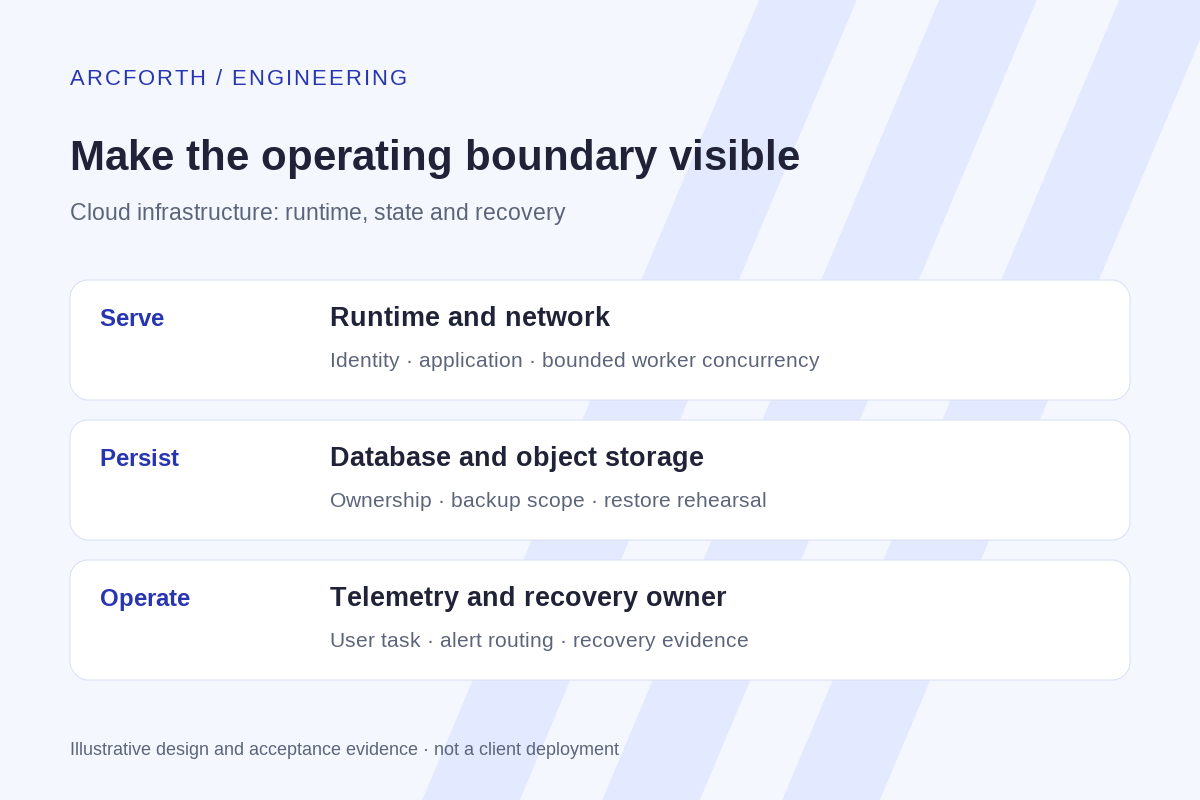
A server answering a health check does not prove a customer can place an order or retrieve a document. Start a cloud infrastructure readiness checklist with one business task and follow its dependencies. The task gives the infrastructure review a boundary and a reason for each check.
Consider a fictional B2B ordering product: a customer submits an order, a worker prepares a receipt, and the receipt is stored with the order record. This example is a rehearsal design, not a report of client incidents or measured uptime. It exposes three different durable states: the order, the background work and the receipt.
02 - Map the Accounts and State Before Changing Capacity
Name the repository, runtime, database, object store, queue, DNS and email or payment provider that the task needs. Record the business owner, technical operator and permitted recovery route. Keep actual credentials out of the worksheet and public tickets; use references to the agreed secret manager or account register.
Separate development, safe test and production boundaries. List which dependencies the test environment substitutes and which it genuinely exercises. A mock email provider is useful for a release rehearsal, but it does not prove production sender configuration. The same distinction applies to payment, model and ERP providers.
03 - Run a Failure Matrix With Observable Results
| Scenario | Expected evidence | Open decision |
|---|---|---|
| The application process stops | A failed user task is visible and routes to an owner | Recovery target and operator coverage |
| The worker receives an order twice | One receipt or an explicitly reconciled repeat | Stable operation identity |
| The object store is unavailable | Order state distinguishes pending receipt from completion | Retry limit and correction route |
| The database backup is restored | A known order can be opened in isolation | Recovery point and elapsed time |
| The previous build is selected | It can read current stored records | Schema compatibility |
Run each scenario in the authorised test boundary. Save the release and configuration reference, safe fixture, observed result and person accepting the evidence. If a required check cannot be performed, leave it unresolved. A green summary should not hide untested dependencies.
04 - Test Recovery as a Whole Workload
Set a recovery time objective: how long the business can tolerate the affected task being unavailable. Set a recovery point objective: how much recent state it can tolerate losing. These are business decisions before they become backup configuration.
Restore the agreed backup into an isolated environment and verify a known order and receipt. Confirm the necessary configuration and access can be reconstructed without copying production secrets into a test report. Inspect scheduled work and external side effects before starting workers against restored data. Replaying an old job must not send an unintended message or create a second provider transaction.
AWS backup guidance includes recovery testing and protection of backup access. Our checklist applies that review to the whole fictional ordering task. A successful test supports only the recovery path and data sources actually exercised.
05 - Separate Release Recovery From Data Recovery
A code revert changes the application version; a data restore changes stored history. They should not share a blind trigger. First establish whether the old application can still operate on the current schema. Where possible, plan compatible changes that allow an application recovery while preserving valid customer activity.
If stored data is damaged, identify the affected boundary, recovery point, replay implications and business approval before a restore. The deployment service explains how to scope migration checks and release decisions. The deployment rehearsal sheet separates the application target from the data decision.
06 - Budget the Operating Boundary and the People
Record the baseline runtime, database, storage, egress, telemetry and external-provider assumptions. Add peak traffic and retained data. Compare the same workload and support boundary across proposals; an instance price alone is not the monthly cost to operate a product.
For US, UK, Dubai/UAE, European and Australian delivery, choose the provider region and review time zone explicitly. Keep support coverage distinct from development overlap. A team available for an agreed review is not automatically a 24-hour incident service. These decisions belong in the operating plan.
07 - Use a Small Release to Inspect Ownership and Recovery
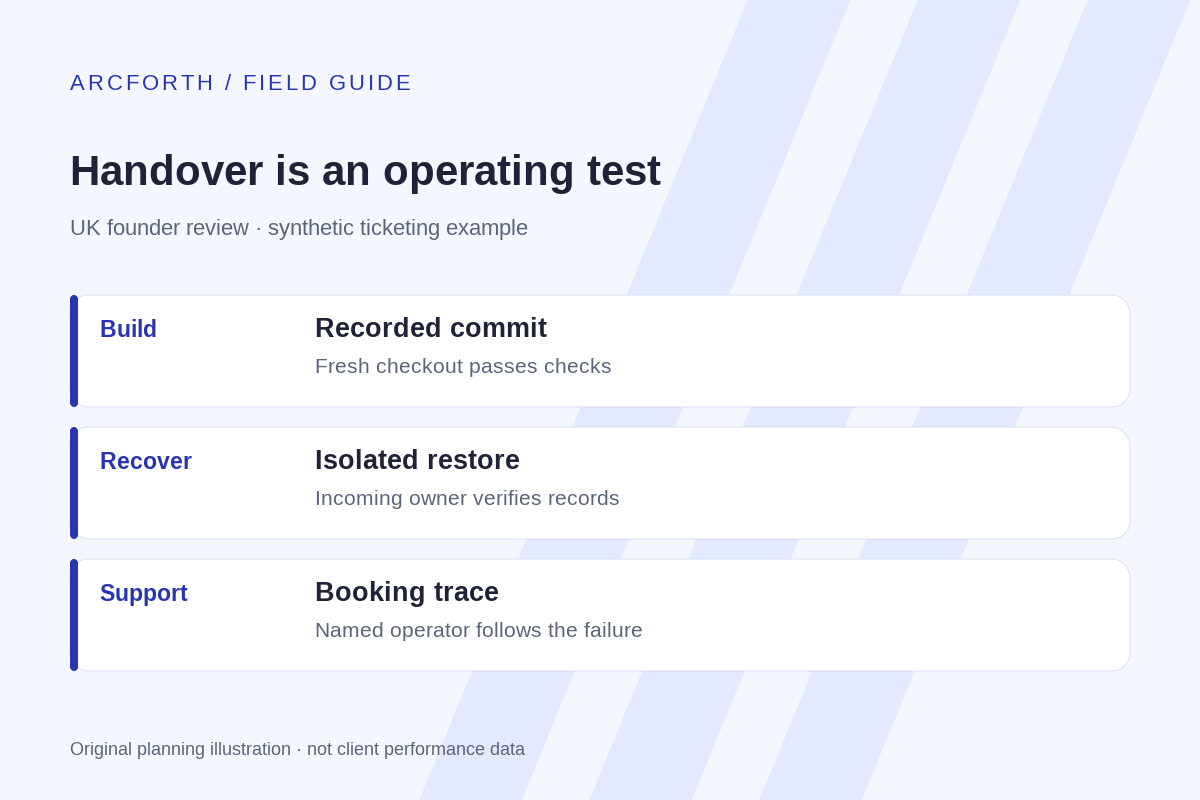
A useful review meeting ends with an accepted task and a decision log. For the fictional ordering product, choose an existing order and one representative receipt. Ask the incoming operator to identify the application version, database and object-storage record that make that receipt available. Next, show the worker state and explain whether it is complete, pending or waiting for an authorised correction. This links the infrastructure inventory to a customer result that a product owner can recognise.
Treat a missing owner as an open finding. An alert that no one receives is different from an alert with an agreed response window. A successful restore in an isolated environment is different from permission to replace live data. Record both what the test showed and the business decision still needed. That evidence gives your team a more useful implementation brief than a long list of cloud products.
Our database architecture guide develops the data boundary, while migration planning covers application and schema compatibility. Use the software handover checklist to rehearse the incoming engineer’s access. These are related engineering tasks, each with its own acceptance evidence.
The CollectiveSpend case study shows a product journey connecting requests and approvals. It is relevant context for selecting a representative task; the public case does not publish a disaster-recovery benchmark. Apply the cloud infrastructure readiness checklist to your actual dependencies and record your own results before making availability claims.
08 - Leave With Evidence and a Scoped Next Step
Download the cloud readiness evidence register and complete it with private evidence references, owners and unresolved decisions. Do not put passwords or production customer records into the public template. The result should tell you whether the next engagement is an architecture review, a specific reliability repair or a release implementation.
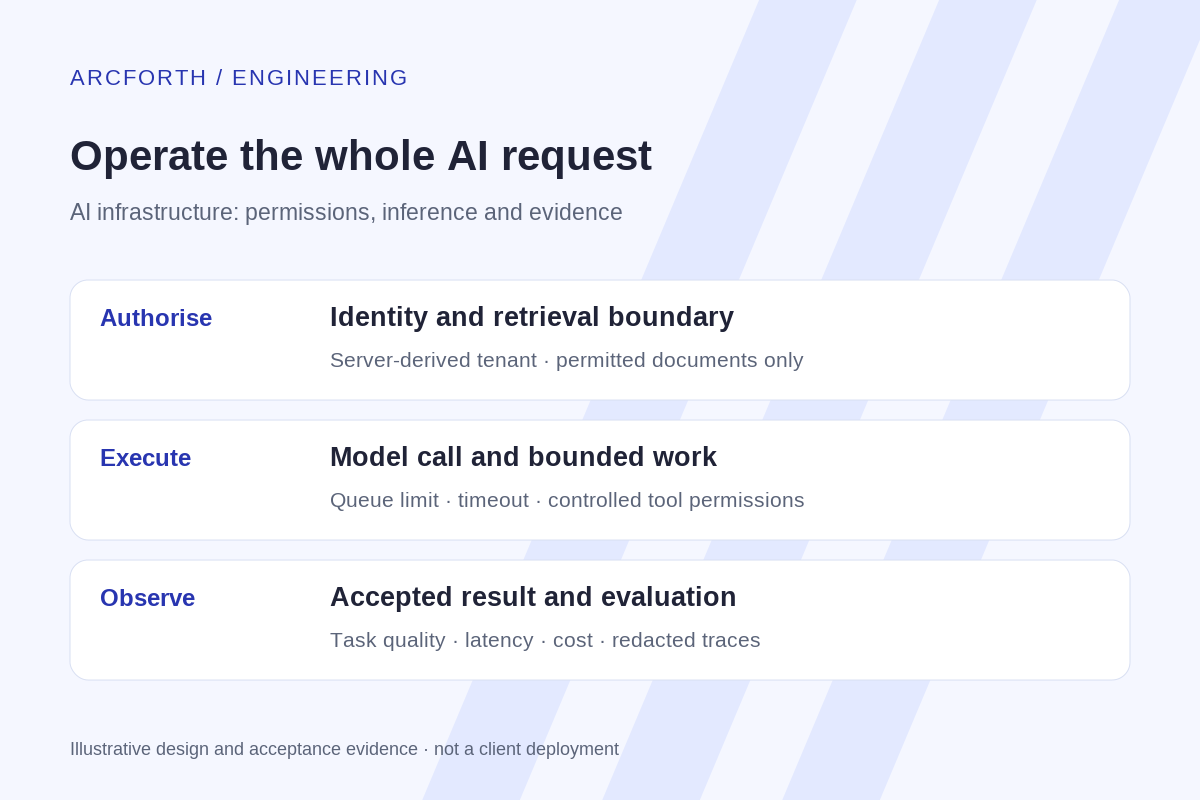
Review cloud infrastructure services for that implementation boundary. For an AI request, add retrieval, inference and evaluation checks; a healthy application process alone does not establish an accepted model result. Bring the failed or unproven task to the first conversation.
Frequently Asked Questions
What makes this different from a server setup checklist?
It starts from a complete customer task and records recovery, provider dependencies, operating owners and actual rehearsal evidence.
Should we restore a production backup during the first review?
Only within an explicitly authorised handling and test scope. Start with safe fixtures and a reviewed recovery plan; do not copy sensitive production data into an uncontrolled environment.
Bring the workload and the missing evidence.
Use the worksheet to record the current boundary, safe test result and operating owner. Scope the specific gap before changing production.
The design, engineering, and product research collective at Arcforth building tomorrow's category-defining digital products.