01 - Start With a Completed Customer Task
AI infrastructure costs are easier to compare when the denominator is a completed customer task. A response can be inexpensive and still need another model call, a document lookup or a reviewer before the user receives an acceptable result. Count those paths before choosing a provider or buying inference capacity.
This guide uses a fictional document-classification workload with deliberately invented prices. It is a calculation method, not a current provider rate card, quotation or client benchmark. The example keeps each assumption visible so a founder can replace it with contracted rates and measured usage.
02 - Calculate AI Infrastructure Costs With Explicit Assumptions
Assume 10,000 task attempts in a planning month, one initial model call per attempt, 1,500 input tokens and 300 output tokens per call. Ten percent of attempts need one identical repeat call. Assume fictional charges of USD 2 per million input tokens and USD 8 per million output tokens.
| Component | Calculation | Illustrative charge |
|---|---|---|
| Initial input | 10,000 × 1,500 ÷ 1,000,000 × USD 2 | USD 30.00 |
| Initial output | 10,000 × 300 ÷ 1,000,000 × USD 8 | USD 24.00 |
| Repeat input | 1,000 × 1,500 ÷ 1,000,000 × USD 2 | USD 3.00 |
| Repeat output | 1,000 × 300 ÷ 1,000,000 × USD 8 | USD 2.40 |
| Model-only total | USD 30 + USD 24 + USD 3 + USD 2.40 | USD 59.40 |
If 9,000 tasks reach the agreed accepted outcome, model-only cost per accepted task is USD 59.40 ÷ 9,000 = USD 0.0066. This excludes retrieval, embeddings, storage, compute, tools, networking, observability, human review, taxes and engineering. The assumed retry call has the same token lengths; a real retry may contain a larger prompt or produce a different output length.
03 - Add the Layers Outside the Model Invoice
List document extraction, embedding and re-indexing, vector or search operations, application runtime, queues, durable storage, egress and retained telemetry. Identify which costs grow per task, which are baseline commitments and which increase with retained data. Include review work and the effect of tasks that fail after consuming resources.
Use the LLM workload planning tool to examine your own assumptions, then check the result against the provider bill and accepted-task count. Do not treat a calculator’s output as a quote. The AI infrastructure workload brief records the model version, contracted rate reference, token distribution and unresolved operating items.
04 - Size Concurrency From a Real Request Path
Write down normal and peak arrivals, calls per task, service time, queue delay and cancellation behaviour. Long-running document jobs and interactive suggestions need different user experiences and limits. A provider accepting a request does not guarantee that the business task completes within the required time.
Bound worker concurrency and retry attempts. Rehearse rate limits, timeout after a possible provider success, and a provider outage. Define the visible user state and the operator who resolves an uncertain result. For an AI agent that can write to a business system, authorise that write through the application and reconcile uncertain delivery before another attempt.
05 - Compare Managed APIs and Dedicated Inference Fairly
An API option pays for provider usage and leaves several serving responsibilities with the provider. Dedicated inference introduces capacity planning, utilisation, deployment, model serving, patching and operating coverage. Compare the same quality target, traffic pattern, latency requirement and data-handling constraints before choosing either.
Do not assume a GPU instance is cheaper because its hourly price looks small next to a projected API invoice. Include idle time, replicas, scale-up behaviour and the team required to run it. Conversely, an API may not satisfy a particular deployment or control requirement. The first decision should make that constraint explicit rather than hiding it inside a universal architecture recommendation.
06 - Keep Quality, Access and Costs on the Same Release Record
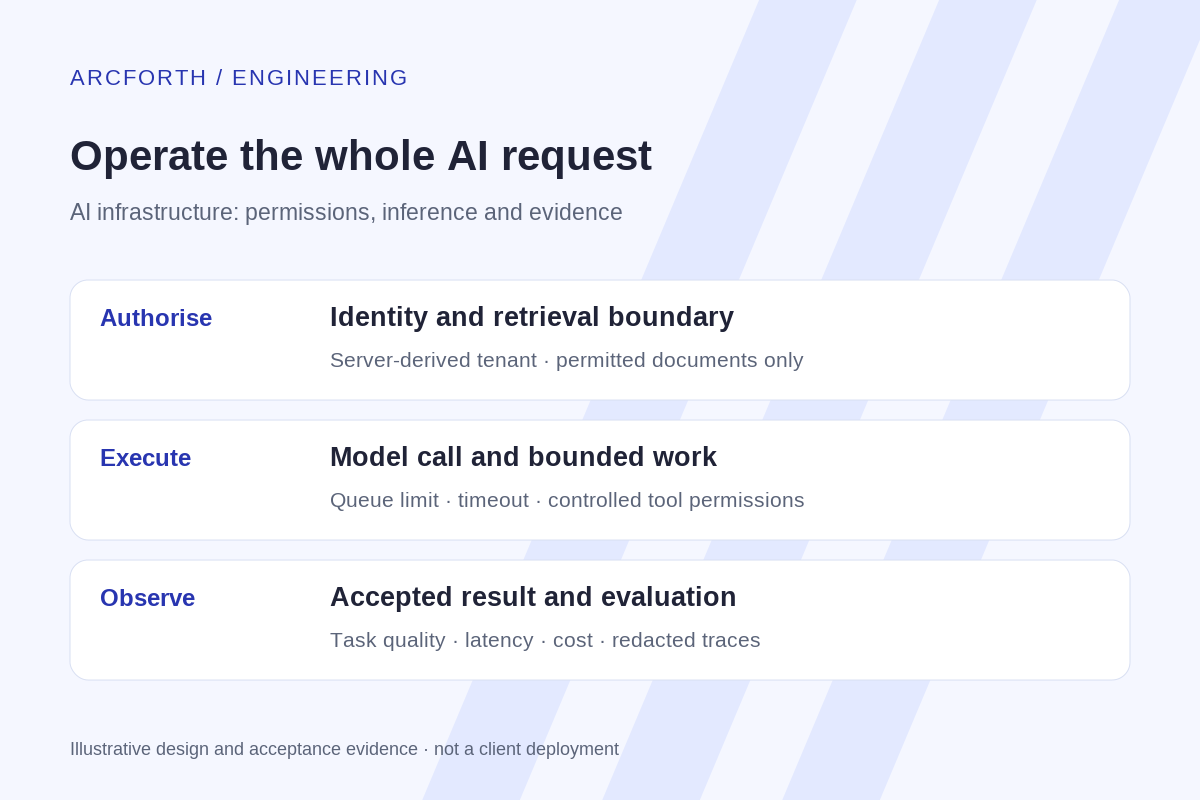
Use a safe evaluation set before changing the model, prompt, retrieval or tool access. Record whether the task was accepted, the failure category, request timing and resource consumption. Review quality and cost together: reducing output length can make a response cheaper while removing information the customer needs.
AWS generative AI observability guidance covers monitoring across application and supporting layers. Microsoft’s multitenant RAG guidance addresses permission-aware retrieval. Neither a low invoice nor a successful model call establishes that the correct customer’s data was used.
07 - Turn the Budget Into an Acceptance Decision
Use the same task cohort for usage and accepted outcomes. In the synthetic example, there are 10,000 task attempts and 9,000 accepted results. The 1,000 repeat calls are additional model usage, not an extra 1,000 accepted tasks. If a retry succeeds, it changes the status of an existing task. Define that identity before joining provider invoices to product events, otherwise a dashboard can make the denominator look better simply by counting repeat processing.
Keep the operating sheet close to the release record. Store the model and configuration reference, safe evaluation version, planning interval and actual rate reference. Separate measured observations from estimates and missing items. A provider bill may arrive after the product event; label that delay rather than presenting a partial subtotal as the final cost of the platform. Use redacted task references and aggregate counts instead of exporting customer documents into a budgeting worksheet.
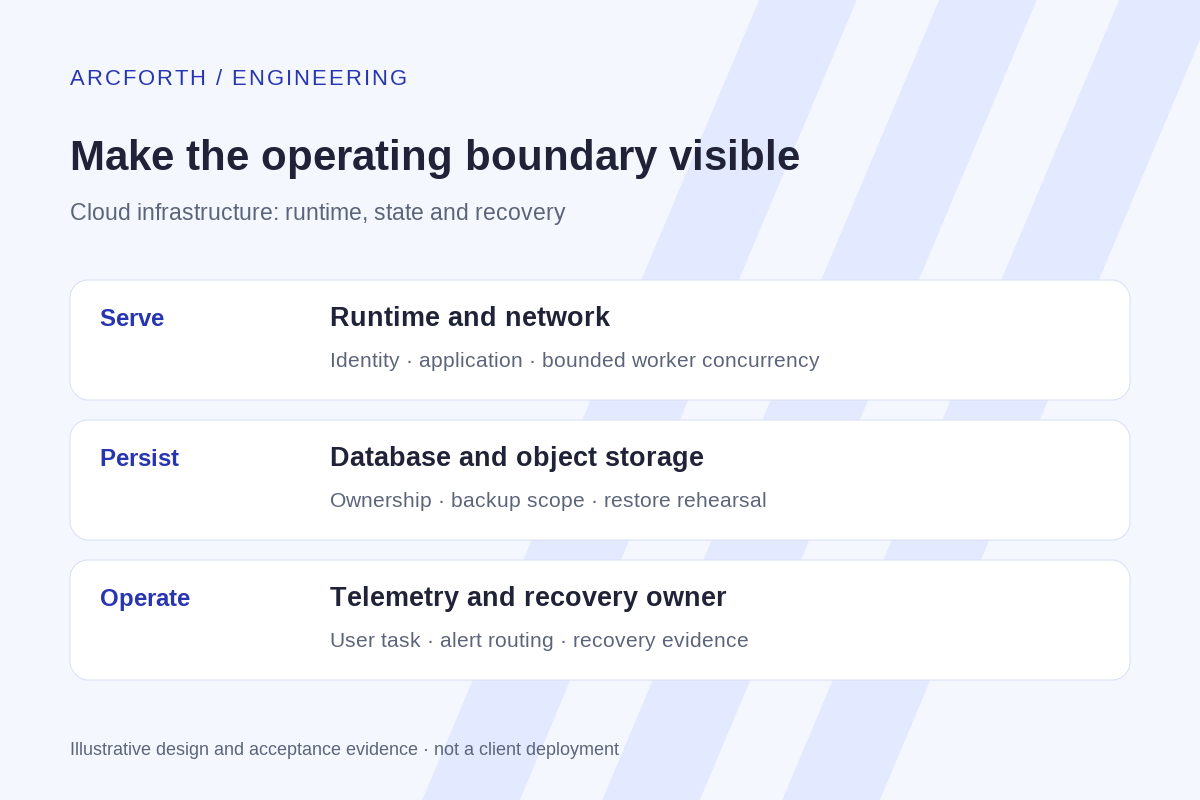
Before selecting a cheaper configuration, run the LLM evaluation examples against it. Compare accepted-task quality as well as resource usage. The AI pilot value review helps define the business outcome, while the cloud infrastructure checklist covers the runtime and recovery dependencies outside inference.
The Skalix AI case shows call, chat and follow-up product work. Its public screens are context for customer tasks, not a published token bill or infrastructure cost benchmark. Calculate AI infrastructure costs from your own traffic and provider terms, then choose the implementation scope that preserves the accepted outcome.
08 - Choose the Market and the First Operating Scope
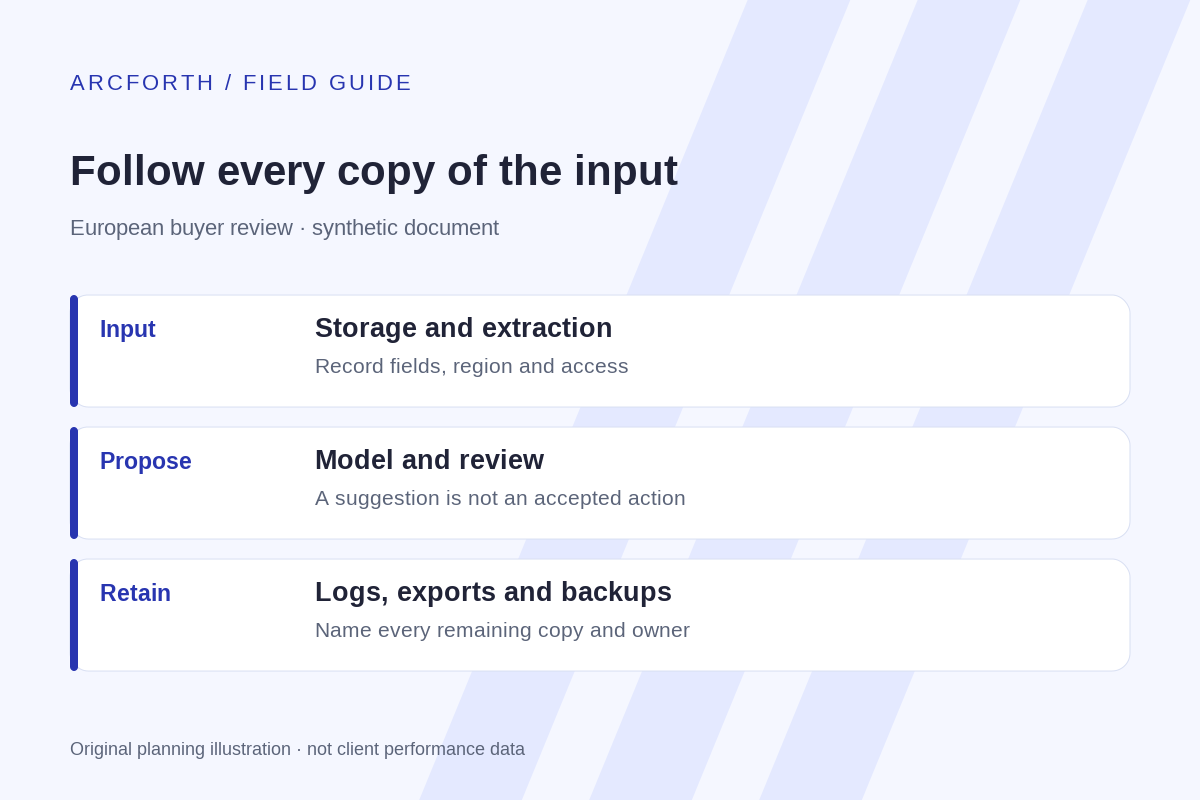
For a Dubai/UAE workload, confirm the actual provider-region options, Gulf Standard Time reviews and any Arabic evaluation examples. For US, UK, European or Australian customers, record the country, time zone, provider paths and support arrangement separately. A locally hosted database does not establish the location of every model request, log or backup.
Use the AI data-flow review for those boundaries and AI infrastructure services for implementation. Bring one task, safe examples, expected volume and the unresolved decision. The useful output is a workload plan with an acceptance test and an operating owner, not a larger list of model names.
Frequently Asked Questions
Are the example model prices current provider prices?
No. They are fictional inputs chosen to make the calculation reproducible. Replace them with your contracted provider rates and actual measured token usage.
Does the USD 59.40 example cover the entire AI platform?
No. It covers only the stated initial and repeat model calls. Retrieval, storage, compute, review, other providers and engineering are outside that subtotal.
Bring the workload and the missing evidence.
Use the worksheet to record the current boundary, safe test result and operating owner. Scope the specific gap before changing production.
The design, engineering, and product research collective at Arcforth building tomorrow's category-defining digital products.