Buyer journey
Define what can be ordered together, which prices and quantities apply and how the buyer understands delivery and exceptions.

Services
A marketplace needs the buyer, seller and platform team to agree on the same transaction. Arcforth scopes the order journey, operational exceptions and settlement responsibilities before expanding the catalogue or storefront.
Define what can be ordered together, which prices and quantities apply and how the buyer understands delivery and exceptions.
Agree onboarding, product data, acceptance of an order, fulfilment updates and the information a seller needs about settlement.
Give the operator a way to resolve stock shortages, delivery problems, returns and disputed records without losing the transaction history.
Choose one marketplace transaction and follow it through buyer confirmation, seller acceptance, fulfilment and settlement. A mixed cart may create several seller orders while the buyer sees one checkout journey. Decide which record represents the buyer purchase and which records the individual sellers operate.
Write down what happens when one seller cannot fulfil its part. The remaining sellers, buyer communication, payment handling and operator workflow all need a consistent answer. The first release should implement those relationships explicitly. A large catalogue and attractive storefront cannot compensate for an order that the platform cannot reconcile.
Consider a wholesale buyer ordering from two makers. One shipment is a small parcel and the other requires a separate delivery assessment. The customer needs a clear total and status, while each maker needs the part they can actually fulfil. This is an example for scoping.
| Event | Decision to agree |
|---|---|
| One seller reports a stock shortage | Which order lines change and who approves the adjustment? |
| A shipment needs manual review | Can the buyer proceed, and what does the operator resolve? |
| A partial return is accepted | How do the buyer refund and seller ledger stay consistent? |
| A provider callback repeats | Which business action has already been processed? |
Use current platform capabilities when deciding what to build. Shopify now documents B2B features across Basic, Grow, Advanced and Plus; do not base a custom build on the blanket claim that B2B requires Plus. Compare your specific catalogue, mixed-order and operating requirements instead.
Payment collection, seller transfers and refunds also need separate design decisions. Stripe’s separate charges and transfers documentation notes that refunding a charge does not automatically change associated transfers. Confirm the chosen provider’s capabilities and the reconciliation responsibility before estimating your settlement workflow.
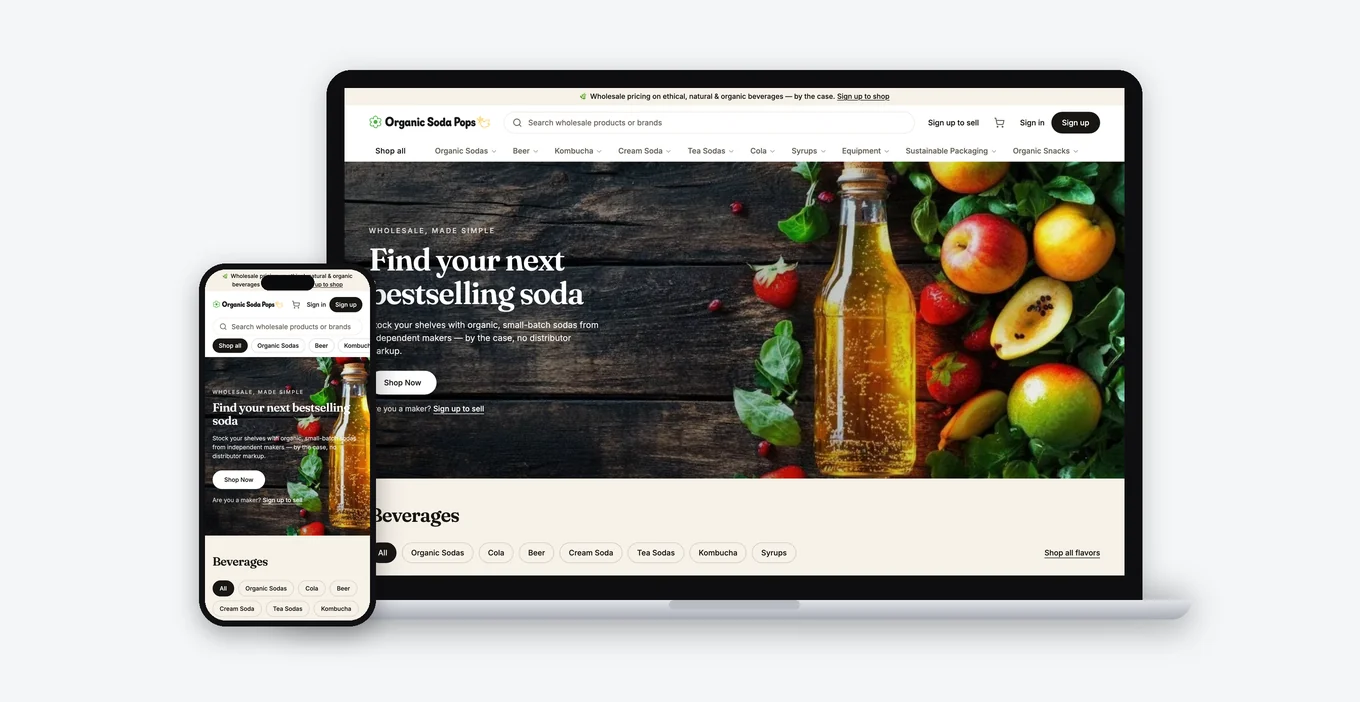
The Organic Soda Pops case describes a wholesale marketplace rebuild with a mixed cart, per-vendor orders, parcel and freight routing, buyer and vendor interfaces and settlement-related work. Its public case identifies a release candidate; it should not be presented as a proven live revenue or conversion result.
Bring the buyer and seller types, one sample transaction, catalogue and quantity rules, delivery assumptions, payment geography and the operator responsible for exceptions. Separate must-have transaction behavior from later discovery and merchandising features. If a simple existing commerce platform meets the first scope, compare that option before committing to custom marketplace engineering. Our build-or-buy tool can help structure your own cost assumptions.
A multi-vendor B2B wholesale marketplace where retailers buy organic drinks by the case from independent makers.
View Organic Soda Pops Case StudyMap one buyer transaction across seller orders, fulfilment and platform operations.
Resolve the stock, delivery, refund and settlement exceptions before freezing scope.
Build the buyer, seller and operator slice with transaction acceptance evidence.
Release the agreed marketplace boundary and assign reconciliation and support ownership.
A Product Pilot ($1,499 once) focuses on one workflow, core flows and prototype, build-ready requirements and an MVP roadmap. A Product Squad ($3,490 per month) supports ongoing product direction, design, engineering and iteration. An Embedded Product Unit (from $5,000 per month) adds capacity for larger products and multiple workstreams.
Compare the exact transaction and operating requirements against current platform capabilities. Custom work should be justified by the gaps that matter, rather than an outdated claim about what a platform can do.
That can be scoped, but the buyer order, seller orders, fulfilment and payment flows need explicit relationships. Agree the partial failure and refund cases as well as the successful checkout.
Do not assume it. Provider behavior depends on the selected payment flow; for Stripe separate charges and transfers, a refund does not itself change associated transfers. Reconciliation and any required transfer adjustment need an agreed design.

If you have committed to a software venture and need a team to shape, build and keep improving it, start with a product conversation.
Human judgment. AI-native delivery. One team accountable from the first decision to every release.