Start the correct customer account
Associate the billing customer and subscription with the intended organisation. Make trial access, payment confirmation and the first useful product task separate decisions.

Services
A checkout success page does not decide everything a customer may do next. Arcforth integrates SaaS billing with organisation accounts, plan permissions and the operating tools needed when payment or subscription state changes. Scope the provider connection and your product’s access policy together.
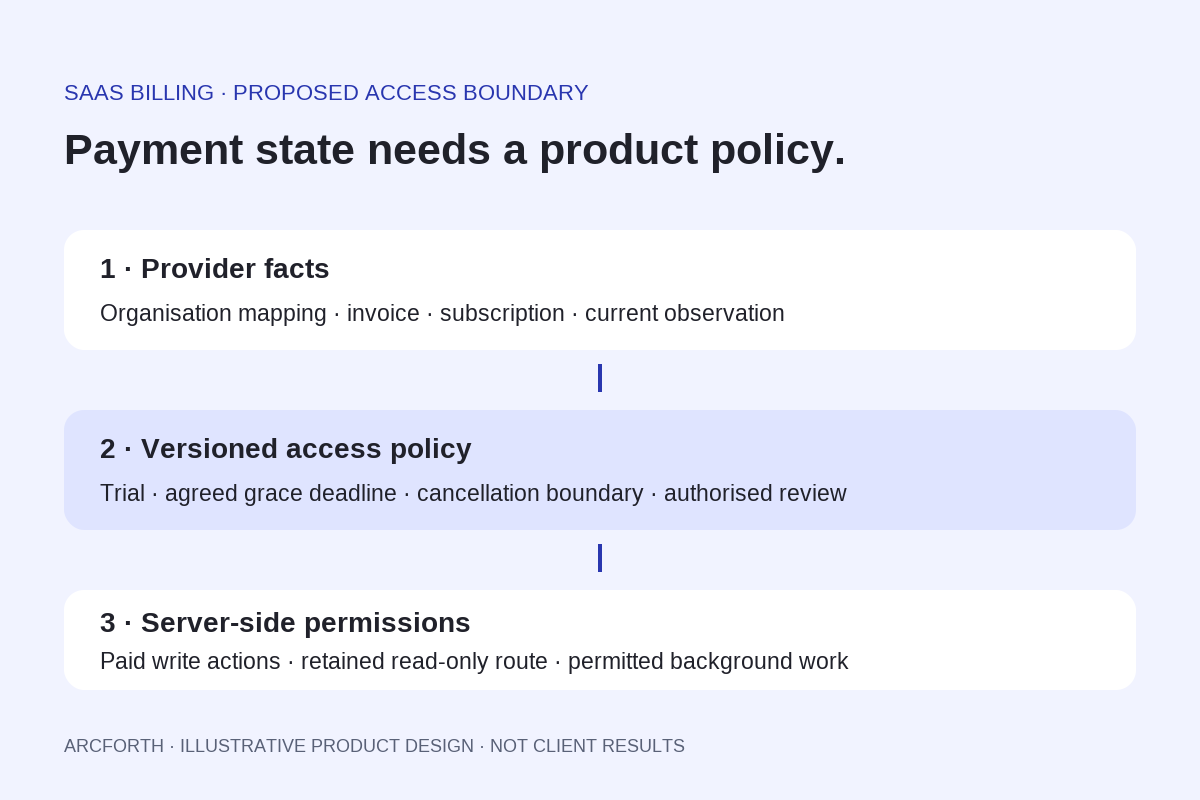
Associate the billing customer and subscription with the intended organisation. Make trial access, payment confirmation and the first useful product task separate decisions.
Define plan changes, seats, failed renewals and cancellation timing. Enforce the resulting permissions in server-side actions as well as the interface.
Show the source subscription, observed provider state, current policy and unresolved processing. Make an authorised correction or replay traceable.
A subscription belongs to a billing customer; a product account may contain several users and workspaces. Decide which organisation the purchase activates, who can manage it and what each plan permits. A team owner changing a payment method should not automatically become an administrator of another customer’s workspace.
Write down the rules for trials, successful renewals, temporary payment problems, scheduled cancellation and the end of access. Separate optional read-only access from permission to create records or run expensive jobs. The subscription access-control guide works through an illustrative failed renewal and recovery.
Stripe documents asynchronous subscription activity through webhook events. A browser returning from checkout is therefore not the only point at which your application must update its understanding. Identify the authoritative billing account, subscription and invoice references for the workflow being implemented.
Our proposed integration boundary is a durable receipt, processing status, provider-state reconciliation and a product access decision. Keep the original provider observation separate from any operator override. An override needs its own owner, reason and expiry rather than silently rewriting the financial record.
Stripe’s webhook guidance covers signature verification, duplicate events and delivery that is not ordered. Design processing so a repeated notification does not apply the same business change twice. Reconcile the relevant current provider record when an old notification could conflict with newer state.
For your app, demonstrate a delayed update, repeated delivery and a restart while work is pending. A handler returning success is only one technical observation. The useful acceptance result is the intended organisation retaining the correct permissions and support being able to trace the outcome.
For a seat-based product, decide whether a billable seat means an invitation, an accepted member, an active member or another defined unit. Decide what a downgrade does when current membership exceeds the new allowance. Silently deleting users is a different business action from preventing another invitation.
For usage-based charging, agree the metered event and its deduplication boundary separately from product analytics. A page view, a CTA click and a billable completed task are not interchangeable counters. Do not add metered billing to the first release unless the commercial model actually needs it.
The billing and access test sheet contains twelve synthetic proposed cases with a blank observed-result column. Use a provider sandbox and a non-production tenant to record the expected policy and observed result.
| Case to rehearse | Evidence to inspect |
|---|---|
| Checkout return before confirmation | No premature paid entitlement |
| Repeated successful-payment notification | One intended access transition |
| Failed renewal and grace expiry | The agreed permissions change at the agreed boundary |
| Cancellation at period end | Access ends according to the confirmed policy |
| Another organisation’s billing reference | No cross-account permission change |
These are proposed tests for the integration being commissioned, not results from Arcforth’s own billing flow or a named client’s payment account.
A US SaaS founder may start with self-service trials and paid upgrades. A UK, European or Australian B2B product may also need a finance-approved invoice workflow and several account roles. Agree those real buying and support processes rather than choosing them from a country label. Currency, invoice content, tax handling and cancellation terms are confirmed by the business and its chosen provider.
For related multi-role product work, inspect Ques.uk’s organiser and customer interfaces. The billing lifecycle on this page is a proposed integration scope, not a statement that the case uses a particular subscription provider. B2B SaaS development covers the broader organisation and core-task model.
Bring the current provider, account owner, pricing rules, organisation model, relevant codebase and sandbox access. Include what customers can do during a trial or overdue period and who resolves disputed access. The proposal should identify configuration, application changes, migration work, monitoring and handover separately.
A $1,499 Product Pilot can define the workflow and build-ready requirements; implementation and provider fees are scoped separately. Keep production payment actions under the authorised business owner. See SaaS integration development when the work also connects a CRM or another operating system.

A city-aware event ticketing platform connecting students, organisers and admins on one unified system.
View Ques.uk Case StudyMap the billing customer, organisation and versioned access policy.
Implement and test the agreed provider and server-side access boundary.
Rehearse lifecycle, duplicate and reconciliation cases in a sandbox.
Hand over support evidence, operating ownership and release controls.
A Product Pilot ($1,499 once) focuses on one workflow, core flows and prototype, build-ready requirements and an MVP roadmap. A Product Squad ($3,490 per month) supports ongoing product direction, design, engineering and iteration. An Embedded Product Unit (from $5,000 per month) adds capacity for larger products and multiple workstreams.
Use the authoritative provider state and the agreed application policy. Browser navigation alone is not the complete subscription lifecycle.
Agree the notification, grace period, permitted actions and end-of-access rules before implementation. Demonstrate those transitions and later recovery with synthetic records.
Yes. Review its organisation model, current permissions, provider account and release process, then scope the integration and any migration.
The engineering scope implements the requirements confirmed by the business and selected provider. Provider selection, tax treatment and commercial terms need their own owner.

If you have committed to a software venture and need a team to shape, build and keep improving it, start with a product conversation.
Human judgment. AI-native delivery. One team accountable from the first decision to every release.