Implement one workflow
Connect the permitted data, model, customer interface and reviewer around a task your team can evaluate.

Services
Arcforth offers AI as a Service for teams that need ongoing product and engineering work around an AI workflow. Define what the system should complete, implement it in your product, and review quality, cost and the next release with an accountable team.
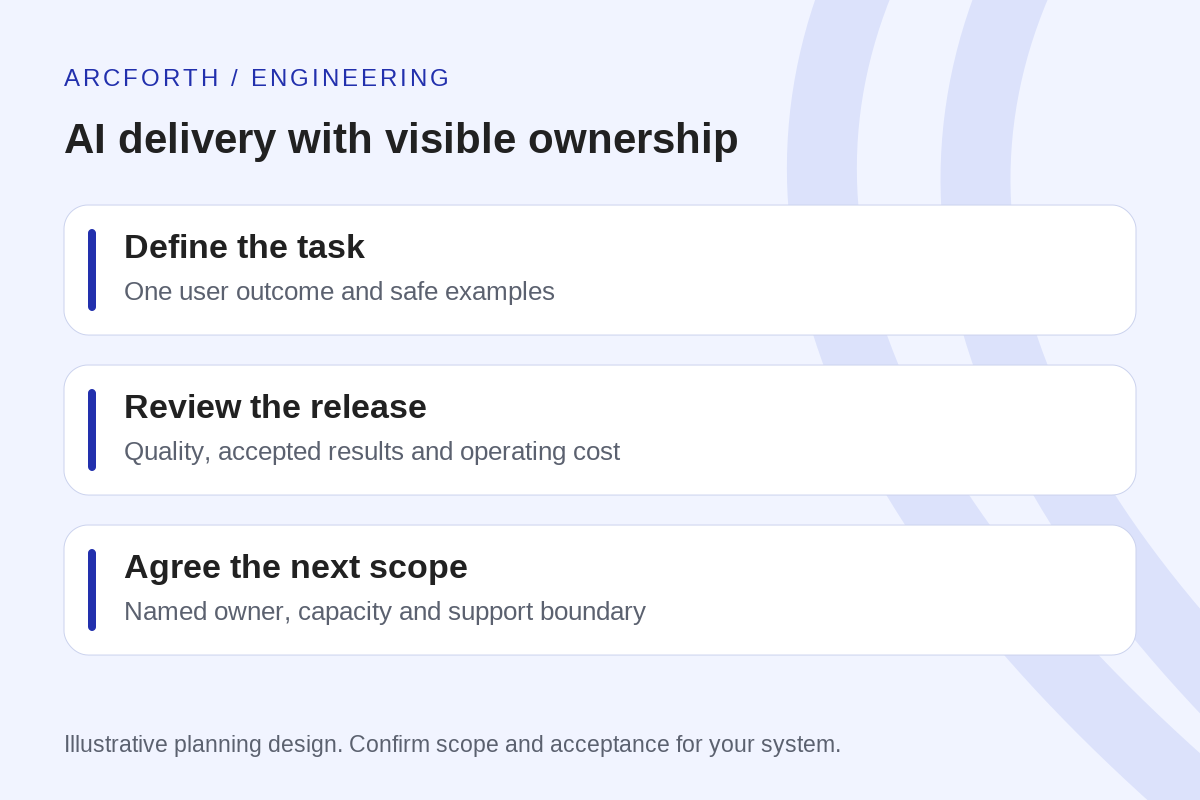
Connect the permitted data, model, customer interface and reviewer around a task your team can evaluate.
Review failed tasks, integration changes and model updates before deciding what the next release should fix.
Name who monitors the workflow, handles exceptions and approves changes; confirm coverage and provider charges separately.
The term can describe a model API, a hosted AI product or a team providing continuing implementation. This page describes the third arrangement. Arcforth supplies agreed product and engineering work; your provider accounts, model usage and business decisions have explicit owners. Buying a monthly engagement does not automatically include a proprietary foundation model, dedicated GPU estate or round-the-clock incident cover.
Start from the task your users need to finish: preparing a support draft, classifying an inbound document or creating a reviewable recommendation. Record the current workflow and who accepts the output. If a ready-made product already completes that job, compare configuring it with building an extension. The first useful result can be a decision to use an existing system rather than commissioning another application.
Separate delivery work from provider operations. A release may change the retrieval source, repair a failed CRM handoff or improve a reviewer screen. Operating work may examine failure categories, queue delays and accepted-task costs. A useful monthly scope says which of these activities the team covers, what evidence it produces and which owner can approve the work.
Use the managed AI monthly scope guide and its editable register to compare proposals on the same basis. Agree the review rhythm, included capacity, change process and escalation route. Record work that remains with your own staff, hosting provider or integration vendor. A list of model names cannot tell a founder who will resolve a customer task that stops halfway.
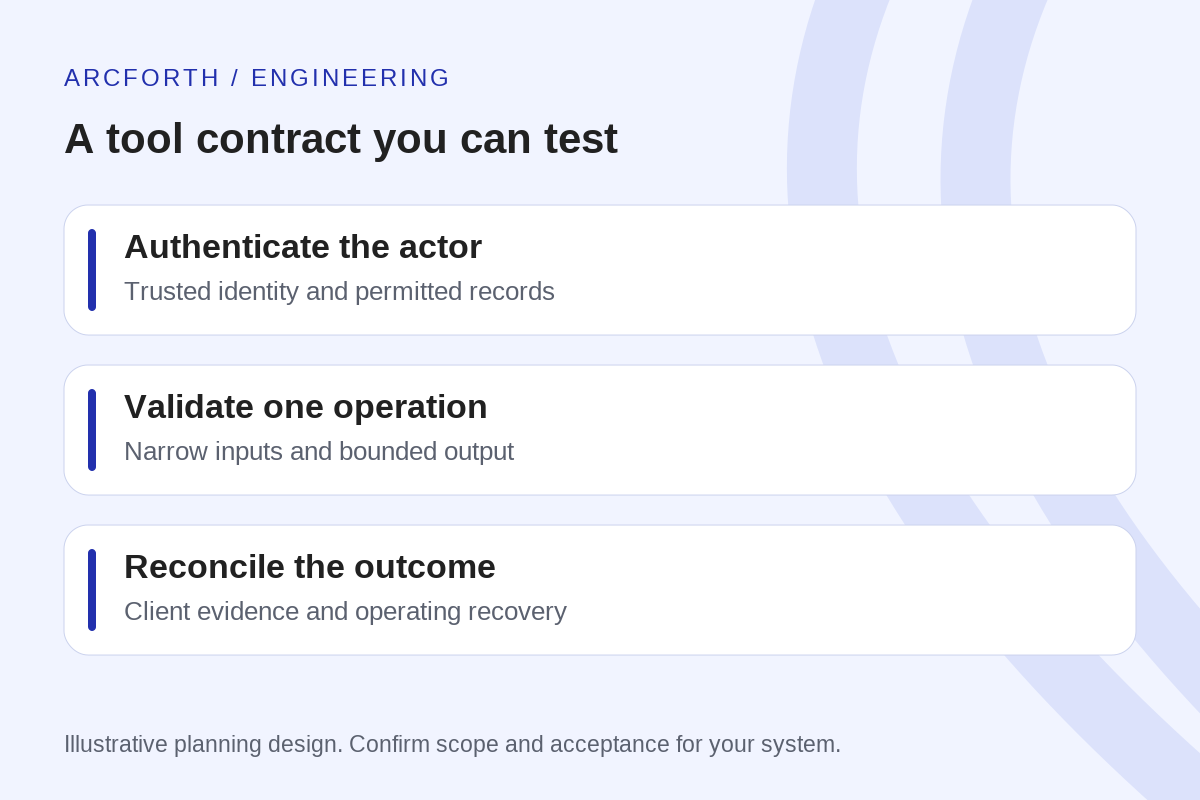
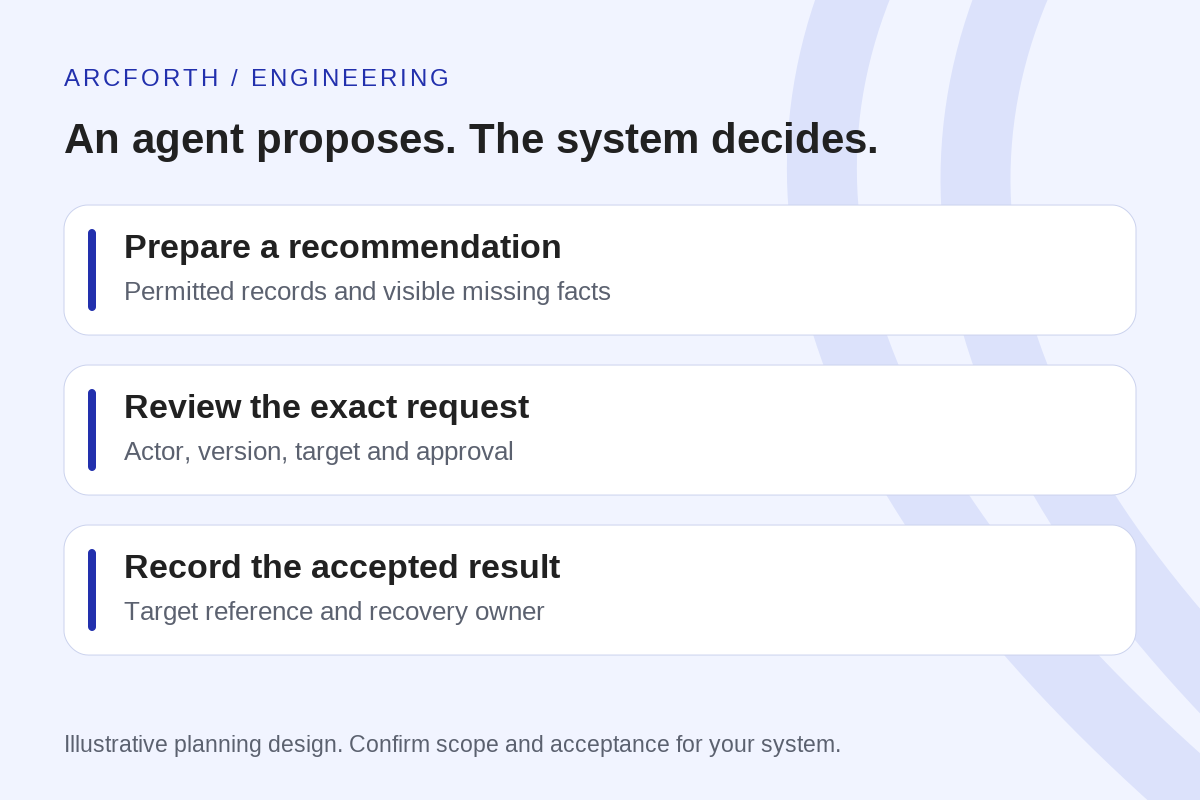
Imagine a software product whose operators answer customer questions using account records and an approved knowledge base. The AI prepares a draft, cites the permitted material and leaves sending to the operator. The application derives the account from the authenticated user. A customer identifier suggested in a conversation does not grant access to another account.
Define acceptance examples for a normal answer, missing evidence, an outdated policy and a request for another customer’s information. Record what happens if the model provider fails after the operator has started work. Keep the original reply route usable. This is a proposed engineering example, not a statement that every named Arcforth client uses this exact design or has achieved a measured cost reduction.
Choose safe evaluation examples and compare the same tasks before changing a prompt, model or integration. Track accepted outcomes, reviewer corrections, resource use and failures. Our AI infrastructure cost guide explains why retries and rejected results belong in the calculation. The LLM workload planner helps test explicit assumptions; its estimates are not provider quotations.
Google Cloud’s agent observability discussion reinforces the need to consider evaluation, resource use and operating evidence together. The provider-specific capabilities still need checking against your actual account and architecture. Our engagement should identify which observations are available, who reviews them and which change they justify.
Skalix AI shows related product work connecting conversations, follow-up and CRM workflows. Livespace.ai shows a different AI product journey around room visualisation. Inspect the published interfaces and workflow descriptions. They establish relevant experience; they are not a universal benchmark for your operating cost, model accuracy or sales outcome.
If you already have an engineering team and need one capability added to a live SaaS product, start with AI feature integration. If the main gap is runtime, retrieval capacity or evaluation infrastructure, use AI infrastructure consulting. An ongoing engagement should follow the work your product actually needs, with a boundary clear enough to change later.
Arcforth delivers remotely. A US engagement should name the actual Eastern, Central or Pacific review window. A UK engagement should account for GMT and BST changes. A Dubai/UAE engagement should agree Gulf Standard Time reviews, the operators involved and any Arabic evaluation examples. European and Australian teams should record their own schedules and system constraints rather than inheriting a generic promise of overlap.
Bring a representative task, safe examples, current product access requirements and a person who can approve priorities. The proposal confirms monthly deliverables, engineering capacity, billing terms, provider costs and any operating coverage. Agree how work pauses, how access is removed and what an incoming team receives. Those practical details make continuing AI work reviewable even when the initial feature has already launched.
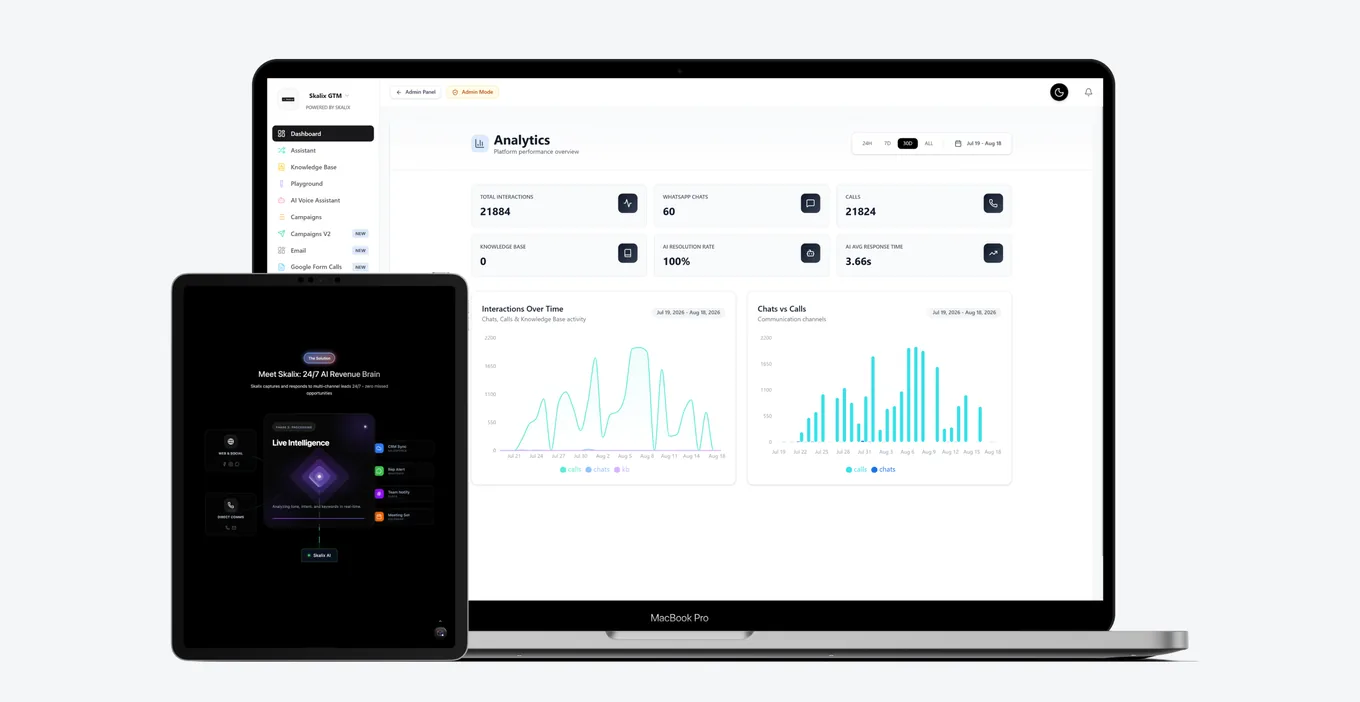
An AI-native revenue platform for calls, chat and customer follow-up.
View Skalix AI Case Study
An AI platform where designers productize their style and homeowners try it in their space.
View Livespace.ai Case StudyDefine the user task, system owner and permitted data or action.
Test safe examples and agree the acceptance evidence and exclusions.
Implement the agreed workflow, evaluation and release controls.
Review accepted results, operating responsibilities and the next change.
Bring one workflow, its accepted result, current systems and an operating owner. Agree the first assessment and monthly responsibilities before committing to continuing work. Provider charges, engineering capacity and support coverage are confirmed in the proposal.
This is an ongoing product and engineering service. Model APIs, hosting and other provider charges have their own contracts and budgets. The proposal specifies what Arcforth delivers.
Yes. Bring the workflow, safe examples, failure cases and current system owners. We assess the next useful implementation or operating scope before extending the engagement.
Coverage, response arrangements, incident ownership and escalation must be agreed explicitly. A monthly development engagement does not automatically include continuous support.
The proposal defines delivery capacity, responsibilities, exclusions and commercial terms. Provider usage and external services are identified separately rather than being hidden inside an unlimited AI promise.

Scope the monthly implementation, evaluation and review work your product needs with Arcforth.
Agree the first deliverable, access and operating responsibilities before implementation.