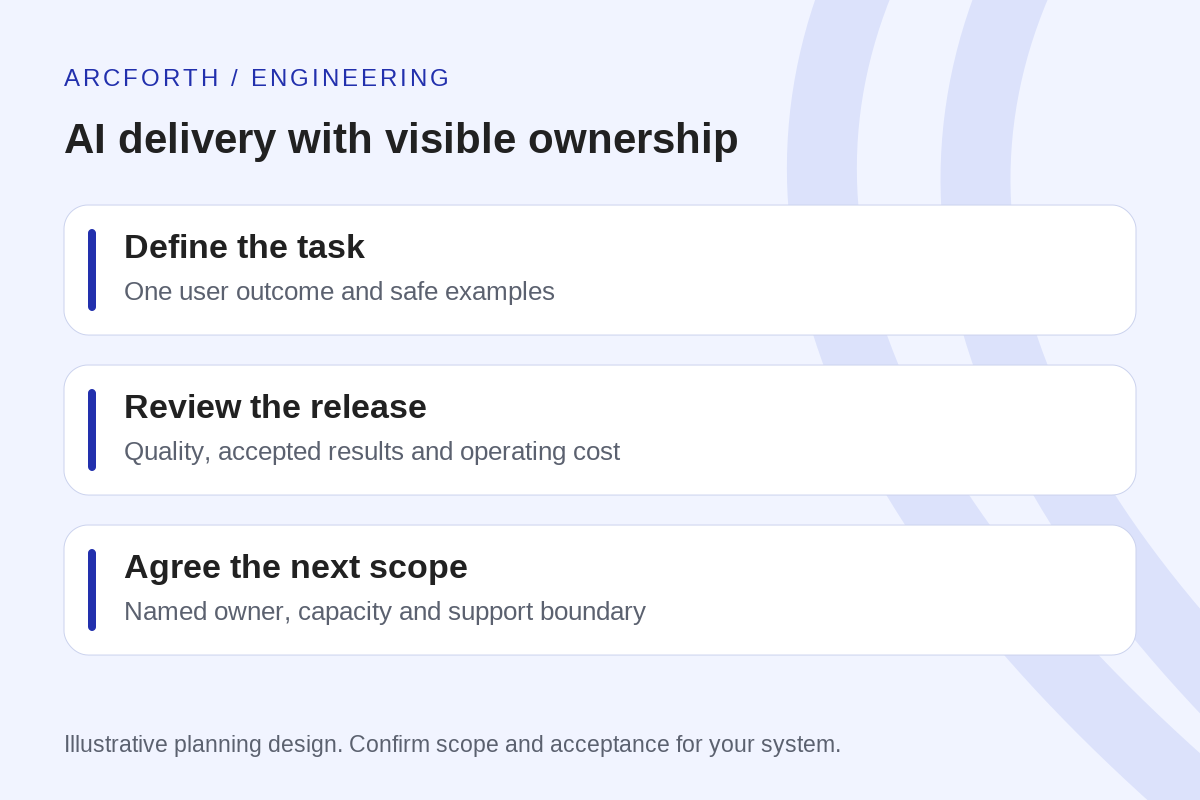
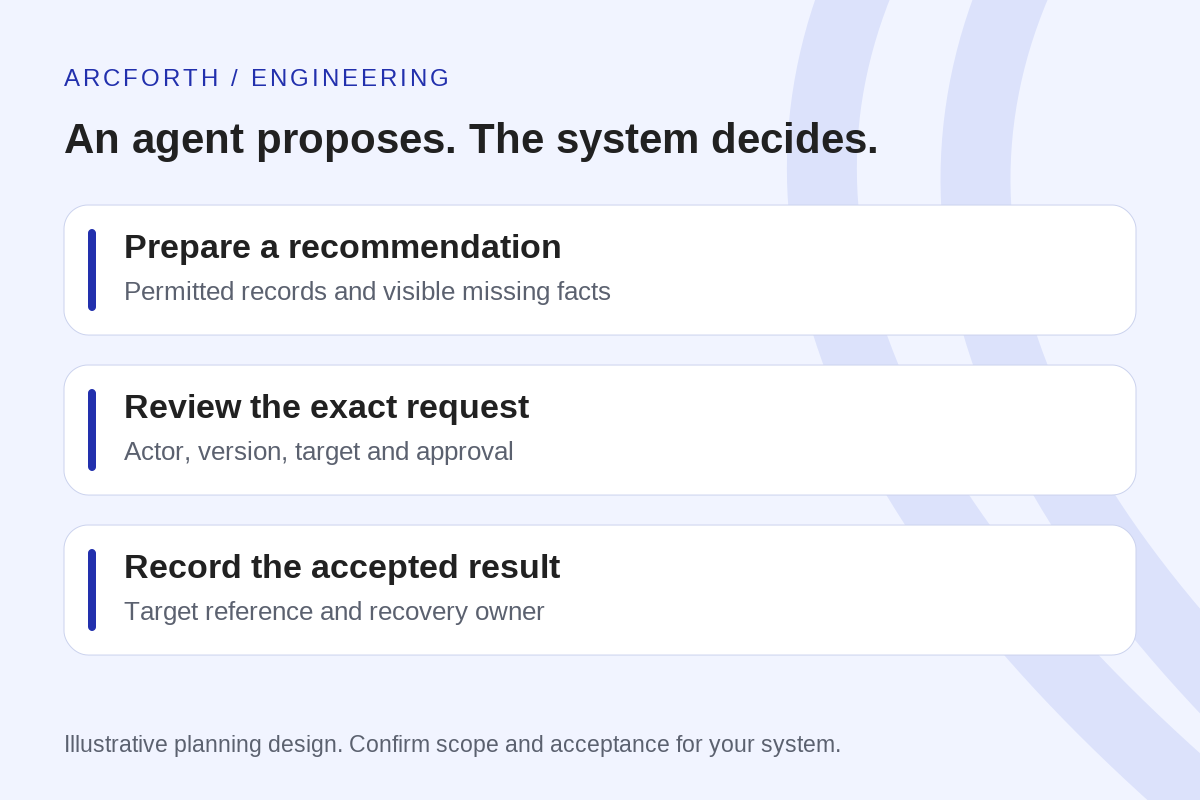
Expose a narrow capability
Describe the accepted inputs, bounded outputs and business meaning of one tool.

Services
Arcforth provides MCP server development for teams exposing useful capabilities from business software to AI clients. Start with one narrow tool, an explicit data boundary and acceptance tests that show what the integration can and cannot do.
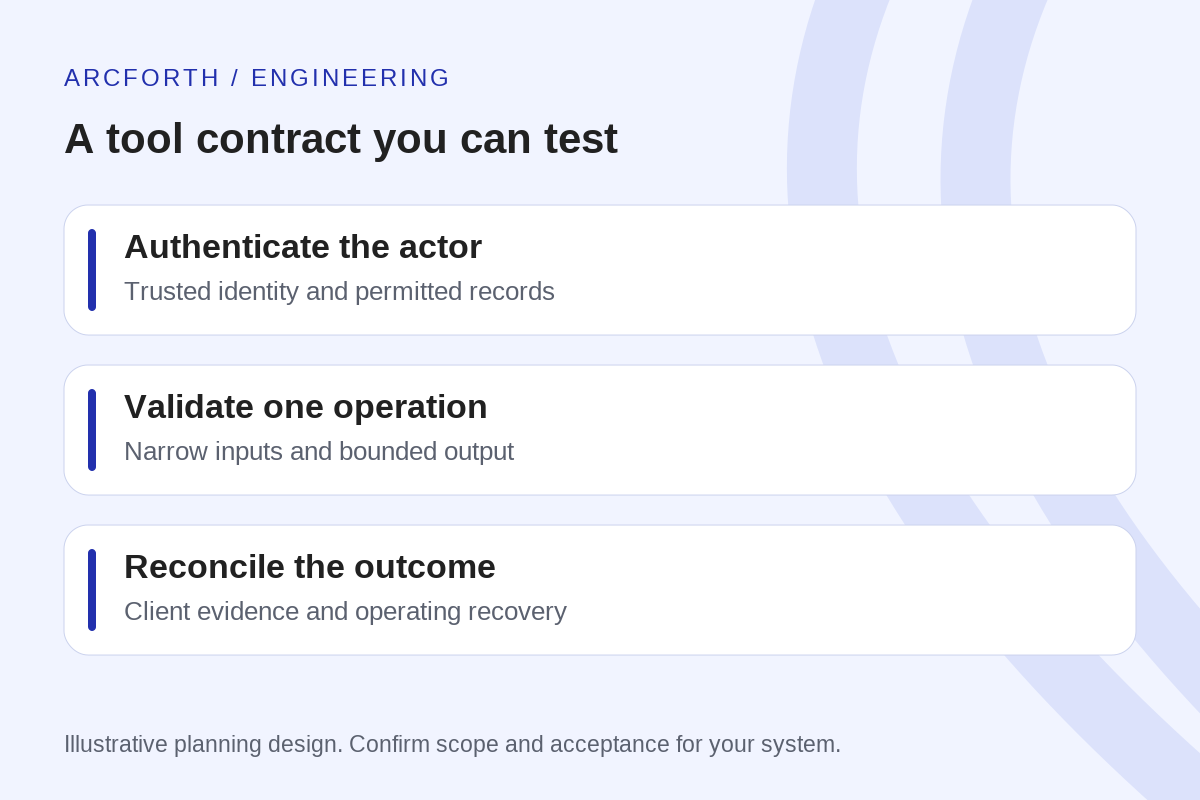
Describe the accepted inputs, bounded outputs and business meaning of one tool.
Derive permissions from trusted identity and validate the target operation at the server.
Agree the supported client and protocol versions, transport and failure behaviour before release.
Model Context Protocol gives an AI client a structured way to discover and call server capabilities. Your implementation still owns the business meaning of each operation. A generic tool that accepts an arbitrary URL, query or instruction creates a very different scope from a tool that validates one known record type. Begin with the smallest useful contract and the system owner who can approve it.
Decide whether the server provides public calculations, access to private records or a write into a business application. Those are different trust boundaries. Record the supported clients, protocol revision, transport, runtime and integration account. A statement that an MCP endpoint exists is not enough to show that the right user can complete a specific task safely.
The Arcforth CSV import validator is a working public example with browser-local validation and a remote MCP route. It checks supplied CSV against explicit column rules and returns bounded findings. Use synthetic or redacted data for the remote tool. It does not import records into a database, execute spreadsheet formulas or connect to a private customer account.
This distinction matters when evaluating a supplier. The public example demonstrates a defined tool contract and transport work; a protected CRM, ERP or document integration requires separate identity, access and acceptance work. Ask a proposed delivery team to show the actual operation, its limits and its returned evidence instead of treating every connector as the same integration.
For an illustrative support lookup, accept a bounded case reference and an allowed query shape. Derive the organisation from authenticated identity, then enforce the record boundary in the application. Return the permitted status and a stable reference instead of the whole underlying account record. Define what missing, denied and unavailable results mean to the client.
For a write tool, record the exact operation, target, parameters, approval reference and result. An operator should be able to reconcile an uncertain response with the destination system. Tool descriptions and hints help the client understand the interface; they are not enforcement. The server and downstream application must independently reject an operation that the actor is not permitted to perform.
The MCP authorisation specification describes the HTTP authorisation mechanism. The official security guidance covers integration risks including token passthrough and untrusted destinations. Select the requirements that apply to your actual deployment and pin the reviewed protocol and client versions.
The MCP server security checklist turns a proposed protected-record tool into observable acceptance cases. Test access with separate organisations and revoked permissions. Keep credentials out of model-visible arguments and general logs. The implementation proposal should explain which application checks the user, which system authorises the target action and who can revoke the integration.
A release should demonstrate capability discovery, a valid tool call, rejected inputs, denied access and the client’s behaviour when the downstream application fails. Include a request that times out after a possible write and a repeat of the same business task. Bound request sizes, result sizes and execution time so that one malformed or repeated request cannot silently create unlimited work.
Our production agent guide covers task state and recovery. The cloud readiness checklist helps identify the runtime, telemetry and operator dependencies. Agree the actual evidence that will be handed over: tool schemas, client compatibility results, redacted traces, deployment instructions and unresolved limitations.
A US SaaS team may need a protected support lookup, while a UK operator may need controlled access to event or customer records. A Dubai/UAE procurement team may need an approved request handed to an ERP. Choose the business operation and responsible system owner before selecting a transport. AI agent development defines the workflow using those capabilities; MCP is the integration layer around it.
If the tool becomes part of a continuing product release cycle, ongoing AI delivery can cover agreed implementation and review work. Inspect the Skalix AI product case for related workflow integration experience, while treating your protected MCP deployment as a separate scope. Hosting, provider accounts, supported clients and operating coverage are agreed before release.
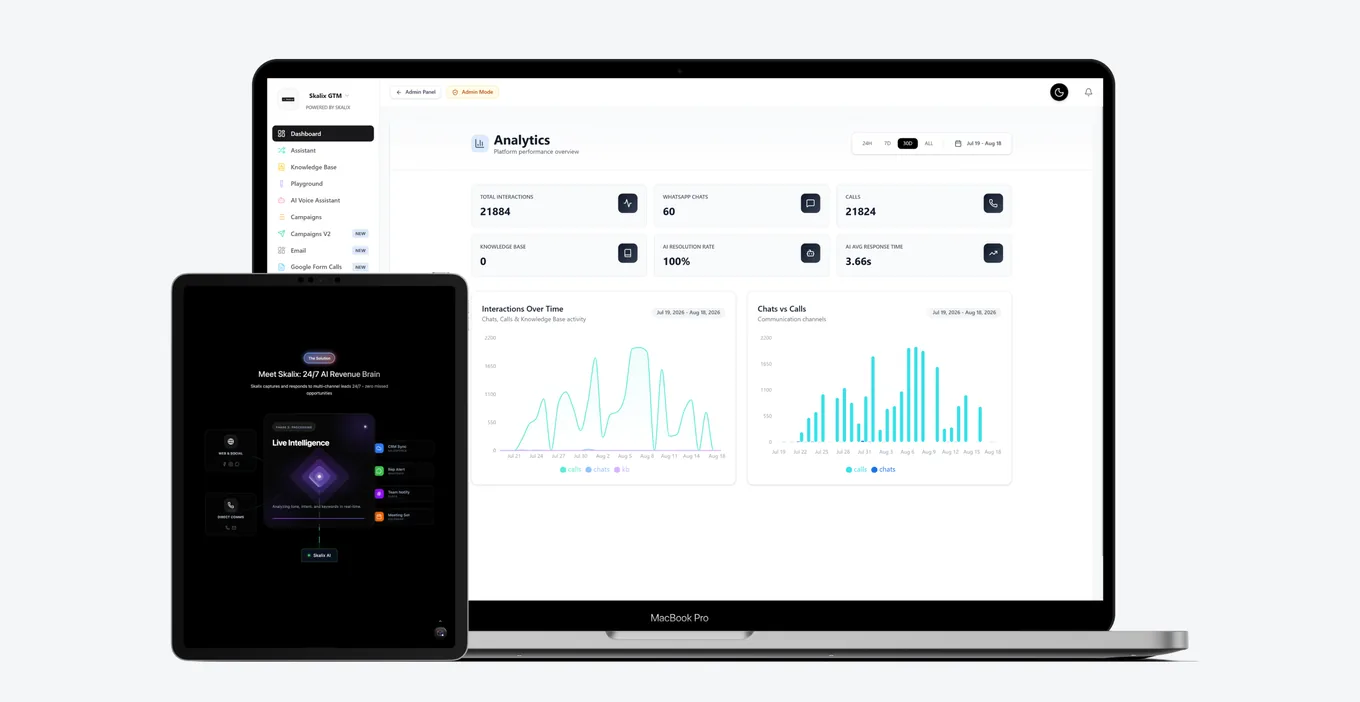
An AI-native revenue platform for calls, chat and customer follow-up.
View Skalix AI Case StudyDefine the user task, system owner and permitted data or action.
Test safe examples and agree the acceptance evidence and exclusions.
Implement the agreed workflow, evaluation and release controls.
Review accepted results, operating responsibilities and the next change.
Bring one system operation, its owner, the required client and safe example inputs. Agree the tool contract, protected access requirements, compatibility tests and operating responsibilities before implementation.
The protocol does not replace application permissions or downstream controls. The scope must define authenticated identity, allowed records, tool limits and the system that authorises each operation.
The public CSV validator provides a bounded example for synthetic or redacted inputs. A confidential-data integration requires its own protected access design and acceptance tests.
Supported clients and versions are agreed and tested explicitly. Do not assume identical capabilities or authorisation behaviour across every client application.
Bring the business operation, API documentation, responsible system owner, permitted sample data and required client. Include current authentication, deployment and support constraints.

Scope one operation, the required client and the access checks that make its result reviewable.
Agree the first deliverable, access and operating responsibilities before implementation.